
 ACP1000 Current Probe
ACP1000 All-in-one AC/DC Current Probe
The ACP1000 AC/DC Current Probe delivers ±1,000A current capability, DC–40MHz bandwidth and ±1% typical high-precision measurement in an industrial-grade rugged design. Built for power electronics R&D, industrial equipment debugging, circuit fault diagnosis and high-power field testing, it combines plug-and-play efficiency, wide environmental adaptability and strong cost-effectiveness for accurate multi-scenario current measurement.
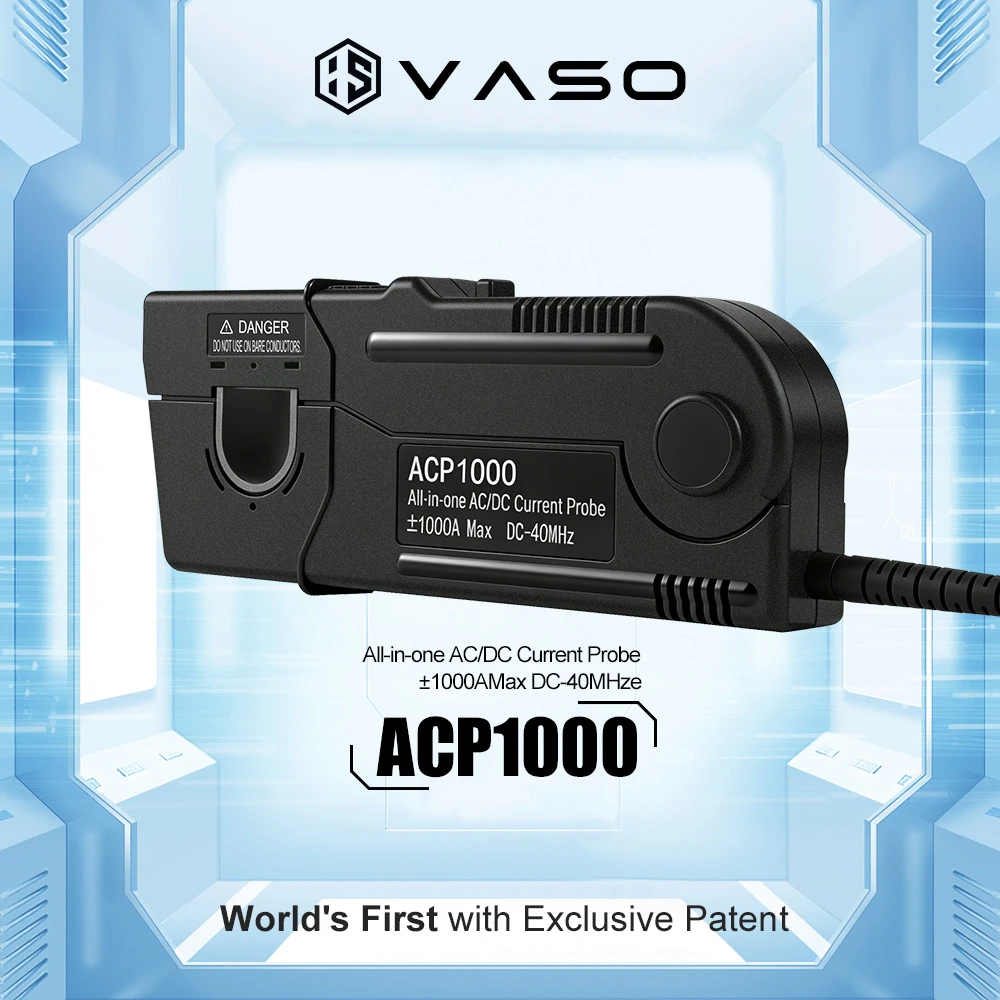
Covers main circuits, buses and high-power modules for large-current testing.
A rare current-bandwidth balance for high-power platform testing.
Supports fast transient observation and high-fidelity waveform capture.
Typical high-precision measurement for reliable engineering validation.
High Cost-Effectiveness for Full-Scenario Current Measurement
Centered on high cost effectiveness, the ACP1000 is equipped with a ±1% high-precision current measurement module and a robust industrial-grade structure. Its wide temperature adaptability, vibration resistance and dust resistance allow the probe to operate in complex industrial testing environments while maintaining stable performance during long-term use.
From Laboratory Validation to Industrial Field Debugging
The ACP1000 supports oscilloscope direct power supply and USB-Type C power supply, enabling plug-and-play operation without complex debugging. Its measurement range covers conventional current detection needs across multiple scenarios, including power electronics R&D, industrial equipment debugging, circuit fault diagnosis and routine current measurement.
Common Platform Benefits Across the ACP Series
The ACP1000 inherits the ACP series platform advantages, combining flexible power, industrial-grade protection, measurement integrity and simplified operation for engineers who need fast, reliable current measurement.
Dual Power Supply Modes
Supports oscilloscope direct power supply and USB-Type C power supply, breaking free from external adapters and enabling flexible laboratory and field testing.
Industrial-Grade Protection
The ACP series uses industrial-grade design with vibration resistance, dust resistance and wide temperature adaptability for both laboratory and industrial-site requirements.
High Precision & Low Distortion
±1% high-precision measurement, low insertion loss and low waveform distortion help engineers obtain true and reliable test results.
Plug-and-Play Operation
Automatic attenuation-ratio setting on compatible oscilloscopes, one-click range switching and simple zero adjustment greatly simplify the testing process.

Connector, Power and Attenuation Setup Made Simpler
Compared with conventional current probes that require an external power adapter and manual attenuation setting, the ACP system reduces wiring complexity and streamlines measurement setup across compatible oscilloscope platforms.
1st–3rd Generation Interface Compatibility
The replaceable adapter design supports oscilloscope interfaces from the 1st generation to the 3rd generation, providing broad platform coverage for engineering teams.
Exclusive Patented Connector Design
The connector enables oscilloscope direct power supply and supports automatic attenuation-ratio configuration on compatible oscilloscopes.
Adapter Replacement Protects Investment
When switching to a different oscilloscope platform, only a simple adapter replacement is needed for compatibility, helping maximize the value of existing instruments.
Less Wiring, Faster Setup
Direct power and automatic attenuation configuration reduce the external adapter burden and simplify the measurement setup procedure.
Designed for Rugged, Accurate and Efficient Current Testing
The ACP1000 adopts a highly stable structural sensor that is rugged and difficult to damage. Extremely low insertion impedance helps prevent sensor overheating, supporting long-duration maximum-current testing. The product is designed for high-dust and high-vibration environments, while its -40℃ to +85℃ operating range extends testing beyond the limitations of many conventional high-frequency AC/DC current probes.
Solving the Practical Limits of Traditional High-Frequency Current Probes
The ACP1000 is engineered around durability, temperature adaptability and sustained high-current capability, addressing several common limitations encountered in current probe selection and long-duration industrial testing.
Fragile Sensor Structures
A new-generation structural sensor design provides robust, durable and difficult-to-break construction, addressing the vulnerability of traditional high-frequency current sensors.
Wider Operating Temperature
The whole unit supports -40℃ to +85℃ operation, breaking the traditional 0℃ to +50℃ limitation often seen in high-frequency AC/DC current probes.
Low Insertion Impedance
Extremely low insertion impedance helps prevent sensor overheating and enables long-duration high-current testing with stable performance.
No High-Frequency Current Derating
The probe supports maximum-current testing without high-frequency derating, maintaining practical measurement capability under demanding conditions.
High-Dust and High-Vibration Use
Industrial-grade dust resistance and vibration resistance allow the ACP1000 to support rugged field environments as well as laboratory benches.
Customization Potential
For special high-bandwidth and high-current scenarios, the product can be customized according to user requirements.

Built for High-Power Platforms That Need Current and Bandwidth Together
The ACP1000 40MHz/1000A model primarily targets new energy vehicles, energy storage, charging piles and heavy-duty power systems. Its industry-rare 1000A + 40MHz combination provides a golden balance between current and bandwidth, covering main circuits, buses and high-power modules without sacrificing bandwidth.
New Energy Vehicles
800V main bus current measurement and high-voltage electric-drive validation for next-generation vehicle platforms.
Energy Storage PCS
Bidirectional converter current testing in energy storage systems where current capacity and waveform behavior both matter.
High-Power Charging Piles
DC fast-charging tests across 250A to 1000A current levels for charging pile development and validation.
Heavy Trucks, Machinery & Ships
Main-circuit measurement for heavy-duty electric power systems and large mobile platforms.
Rail Transit Traction Converter
High-power traction converter current measurement and validation for rail-transit systems.
Electrolysis / Hydrogen Power Supply
Medium-to-high-power power-supply current testing for electrolysis and hydrogen-production systems.
Complete ACP1000 Specification Matrix
This expanded matrix restores the full parameter set from the uploaded ACP1000 document, including power, attenuation, environmental durability, derating and physical probe-head dimensions.
| Parameter | ACP1000 Value | Engineering Meaning |
|---|---|---|
| Maximum Current | ±1,000A | Suitable for high-power buses, main circuits and power modules. |
| Bandwidth | DC–40MHz | Supports high-frequency waveform observation while maintaining high current capacity. |
| Rise Time | ≤8.5ns | Helps capture fast switching transitions and transient details. |
| Accuracy | ±1% typical value; ±3% warranty value | Provides reliable measurement precision for routine and engineering validation tests. |
| Low / High Maximum Current | 100A / 1000A | Two current ranges support both lower-current debugging and high-current testing. |
| Attenuation Ratio | 50X / 500X | Matches the selected measurement range and oscilloscope setup. |
| Minimum Sensitivity | 0.05A / 0.5A | Supports fine current observation within the selected range. |
| Maximum Wire Diameter | 10mm | Defines the maximum conductor size supported by the probe jaw. |
| Maximum Bare Wire Voltage | 300V RMS CAT II; 150V RMS CAT III | Specifies the rated voltage environment for bare-wire measurement. |
| Power Requirements | Oscilloscope direct supply / USB-Type C supply | Allows flexible operation in laboratory and industrial scenarios. |
| Attenuation Ratio Setting | Automatic, depending on oscilloscope | Simplifies setup on compatible platforms. |
| Long-Term Maximum Current Test | Yes | Supports sustained high-current testing. |
| Maximum Current Frequency Derating | No | Maintains maximum-current testing capability without high-frequency decrease. |
| Sensor | Highly stable, unbreakable structural sensor | Improves durability versus fragile traditional sensors. |
| Operating Temperature Range | -40℃ to +85℃ | Extends usage from controlled labs to harsh field environments. |
| High-Dust Environment Use | Yes | Supports industrial field testing. |
| High-Vibration Environment Use | Yes | Supports rugged equipment and industrial-site measurements. |
| Cable Length | 2m | Provides practical bench and field connection reach. |
| Probe Head Length | 17.6cm | Physical head dimension for installation planning. |
| Probe Head Width | 2.2cm | Physical head dimension for installation planning. |
| Probe Head Height | 5.5cm | Physical head dimension for installation planning. |
Matching Rules and Common Selection Priorities
Current probe selection should balance bandwidth, current rating, measurement accuracy, jaw opening diameter and operating environmental conditions. Higher bandwidth does not always mean better performance; the correct probe should match the signal, oscilloscope, current range and noise requirements.
Bandwidth Rule: 3× to 5× Signal Frequency
The probe bandwidth should generally be three to five times the maximum frequency of the measured signal. Rise time, oscilloscope matching, noise performance and current range should be evaluated together.
Oscilloscope Bandwidth Matching
The overall measurement-system bandwidth is determined by the lower bandwidth value between the probe and the oscilloscope. The probe bandwidth should reach at least 80% of the oscilloscope bandwidth; for example, a 500MHz oscilloscope requires a probe with at least 400MHz bandwidth.
Bandwidth and Current Range Balance
High-bandwidth probes of 100MHz and above usually have smaller current ranges of 50A or below, while high-current probes of 100A and above are usually limited to lower bandwidths of 50MHz or below.
Peak Current Margin
The selection standard is sufficient bandwidth plus a current range that covers peak current with 20%–30% additional margin.
Noise Suppression
For low-frequency applications such as 1kHz signals, a 10MHz bandwidth probe is sufficient and can avoid RF noise introduced by excessive bandwidth.
Frequency Flatness
For high-frequency applications, prioritize probes with excellent frequency flatness within ±1dB and resonance peaks outside the working frequency band.
