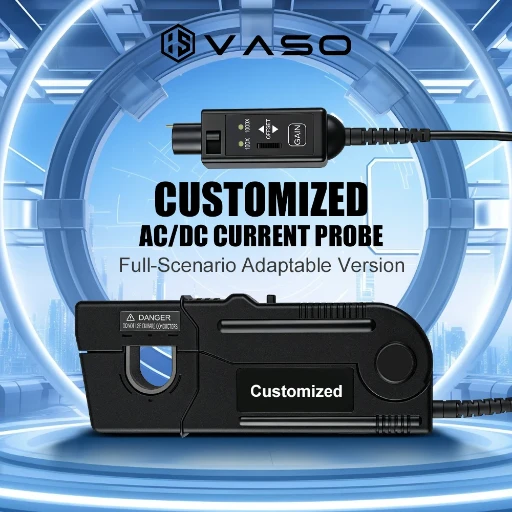
An AC current probe (also called an AC current clamp or clamp-on current probe) is a sensor used in electrical and electronics testing to measure the magnitude, frequency, and waveform shape of alternating current flowing through a conductor.
Unlike resistive shunt methods that require inserting a component into the circuit, an AC current probe uses Faraday’s Law of electromagnetic induction: a conductor carrying AC creates a time-varying magnetic field, and the probe’s toroidal core and winding convert that field into a measurable voltage signal.
Key principle: The output voltage of the probe is proportional to the rate of change of current (dI/dt), making it naturally suited for AC signals rather than DC.
How Does an AC Current Probe Work?
The Physics Behind It
Magnetic Field Generation — When AC flows through a wire, it produces a sinusoidal magnetic field around the conductor.
Core Flux Coupling — The probe’s split ferromagnetic or ferrite core clamps around the wire, concentrating the magnetic flux through the core.
Inductive Sensing — A secondary winding wound around the core picks up the changing flux and generates a voltage output (V = N × dΦ/dt).
Signal Output — This voltage is fed to an oscilloscope (via BNC connector) or a clamp meter display, which converts it back to current units (Amperes).
AC Current Probe vs. Hall Effect Probe
Feature
AC Current Probe (Rogowski / Transformer)
Hall Effect Probe
Measures DC?
❌ No
✅ Yes
Frequency Range
Higher (up to hundreds of MHz)
Lower (DC to ~100 kHz typical)
Accuracy at Low Freq.
Limited below ~1 Hz
Excellent
Circuit Intrusion
None (clamp-on)
None (clamp-on)
Typical Use
High-frequency AC, power electronics
DC bias + AC ripple measurement
Types of AC Current Probes
1. Current Transformer (CT) Probe
The most common type. Uses a toroidal transformer with a fixed turns ratio. Suitable for power frequency (50/60 Hz) to mid-frequency signals. Output is a current (requires burden resistor) or voltage.
Typical bandwidth: 1 Hz – 100 MHz (depends on model)
Common use: Power quality analysis, motor drives, EMC testing
2. Rogowski Coil Probe
A flexible, air-core coil that wraps around a conductor. Because it has no ferromagnetic core, it has no saturation limit, making it ideal for very high currents and fast transients.
Typical bandwidth: 0.1 Hz – 30 MHz
Common use: High-current inverters, pulse power, EV battery testing
Advantage: Lightweight, flexible, immune to core saturation
3. Active AC Current Probe
Combines a passive current transformer or Rogowski coil with an integrated amplifier. Provides flat frequency response over a wide bandwidth and drives low-impedance oscilloscope inputs accurately.
Typical bandwidth: DC-coupled versions up to 1 GHz
Common use: High-speed power electronics, switched-mode power supplies (SMPS), GaN/SiC device characterization
Key Specifications to Understand
When selecting an AC current probe, evaluate these parameters:
Specification
What It Means
Bandwidth (Hz)
Frequency range over which the probe maintains ±3 dB accuracy
Peak Current Rating (A)
Maximum instantaneous current without damage or saturation
RMS Current Rating (A)
Maximum continuous RMS current
Sensitivity (mV/A)
Output voltage per ampere of measured current
Insertion Impedance
Impedance added to the circuit (should be near zero)
Phase Accuracy
Phase error between actual and measured current (critical for power factor measurements)
Common Applications
AC current probes are used across a wide range of industries:
Power Electronics Design — Measuring switching current waveforms in MOSFETs, IGBTs, GaN, and SiC devices
Motor & Drive Testing — Monitoring phase currents in VFDs (Variable Frequency Drives)
EMC/EMI Testing — Characterizing conducted emissions on power lines
Renewable Energy — Solar inverter and wind turbine current analysis
Electric Vehicle (EV) Systems — Battery charging current waveforms and DC-link ripple
Telecommunications Power — Measuring inrush current and load transients
Research & Education — Non-invasive circuit analysis in labs
How to Use an AC Current Probe: Step-by-Step
Connect the probe to your oscilloscope or meter via the BNC output.
Set the scale — input the probe’s sensitivity (e.g., 100 mV/A) into the oscilloscope’s channel settings.
Demagnetize (degauss) the core if your probe has a degauss button, to zero any residual DC offset.
Clamp around a single conductor — never clamp around multiple conductors simultaneously, as opposing currents will cancel.
Route the wire through the center of the jaw opening for best accuracy.
Read the waveform — the oscilloscope displays current in amperes based on the mV/A conversion.
⚠️ Safety Note: Always check the probe’s CAT rating (CAT II, CAT III, or CAT IV) to ensure it is rated for the voltage environment you are working in.
AC Current Probe vs. Clamp Meter: What’s the Difference?
A clamp meter and an AC current probe both use electromagnetic induction, but they serve different purposes:
AC Current Probe (for Oscilloscope)
Clamp Meter
Output
Voltage signal (mV/A)
Direct digital readout
Waveform Capture
✅ Yes — full waveform on oscilloscope
❌ No — RMS value only
Bandwidth
Up to MHz range
Typically 1 kHz or less
Use Case
Waveform analysis, harmonics, transients
Simple RMS current readings
Cost
Higher (probe + oscilloscope)
Lower (standalone)
For waveform analysis, harmonic distortion, or transient capture, an AC current probe connected to an oscilloscope is the correct tool. For a quick RMS reading in the field, a clamp meter suffices.
Leading Manufacturers
The following brands are well-regarded in the test and measurement industry for AC current probes:
Tektronix — TCP series; widely used in power electronics labs
Keysight (Agilent) — N2780 series; known for precision and bandwidth
Pearson Electronics — High-bandwidth pulse current monitors
Frequently Asked Questions (FAQ)
Q: Can an AC current probe measure DC current? A: Standard transformer-based AC current probes cannot measure DC, because they rely on changing magnetic flux. To measure DC or DC+AC, use a Hall effect–based current probe.
Q: What bandwidth do I need for SMPS testing? A: Switched-mode power supplies typically switch at 50 kHz–1 MHz. You should use a probe with bandwidth of at least 5–10× the switching frequency — so 500 kHz to 10 MHz minimum.
Q: Why does my probe read inaccurately at low frequencies? A: Transformer-based probes have a low-frequency roll-off due to their finite magnetizing inductance. For accurate measurements below ~1 Hz, use a Rogowski coil with an integrator or a Hall effect probe.
Q: What is the difference between a 1 A/V and 100 mV/A sensitivity rating? A: These are the same specification expressed differently. 100 mV/A means the probe outputs 100 millivolts for every 1 ampere measured. 1 A/V means 1 ampere of current corresponds to 1 volt — indicating a 1 V/A sensitivity, which is a higher-gain probe.
Summary
An AC current probe is an essential, non-invasive tool for measuring alternating current in electrical and electronic systems. By exploiting electromagnetic induction, it captures not just the magnitude but the full waveform shape of AC signals — enabling engineers to diagnose harmonic distortion, characterize switching behavior, and ensure power quality across a wide range of applications.
Choosing the right probe requires matching its bandwidth, current range, and sensitivity to the specific measurement task. For most power electronics work, an active current probe with at least 10 MHz bandwidth provides the accuracy and dynamic range needed for reliable results.
The current probe is rarely what engineers argue about. Budgets go toward the power analyzer, the oscilloscope, the dynamometer. The probe gets picked from whatever
Testing high-current circuits—especially in EV charging systems, inverter burn-in, or industrial motor drives—exposes a recurring problem: most 300A probes aren’t built for the job. They


 English
  French
  Russian