
ACP3000 ±3000A Max DC–30MHz Current Probe
ACP3000 is VASO's ultra-high-current all-in-one AC/DC current probe for megawatt-level, grid-level and large-bus applications. It combines ±3000A current capability, true DC–30MHz bandwidth, a patented oscilloscope connector system, rugged sensor architecture and simplified setup for demanding high-power measurement environments.
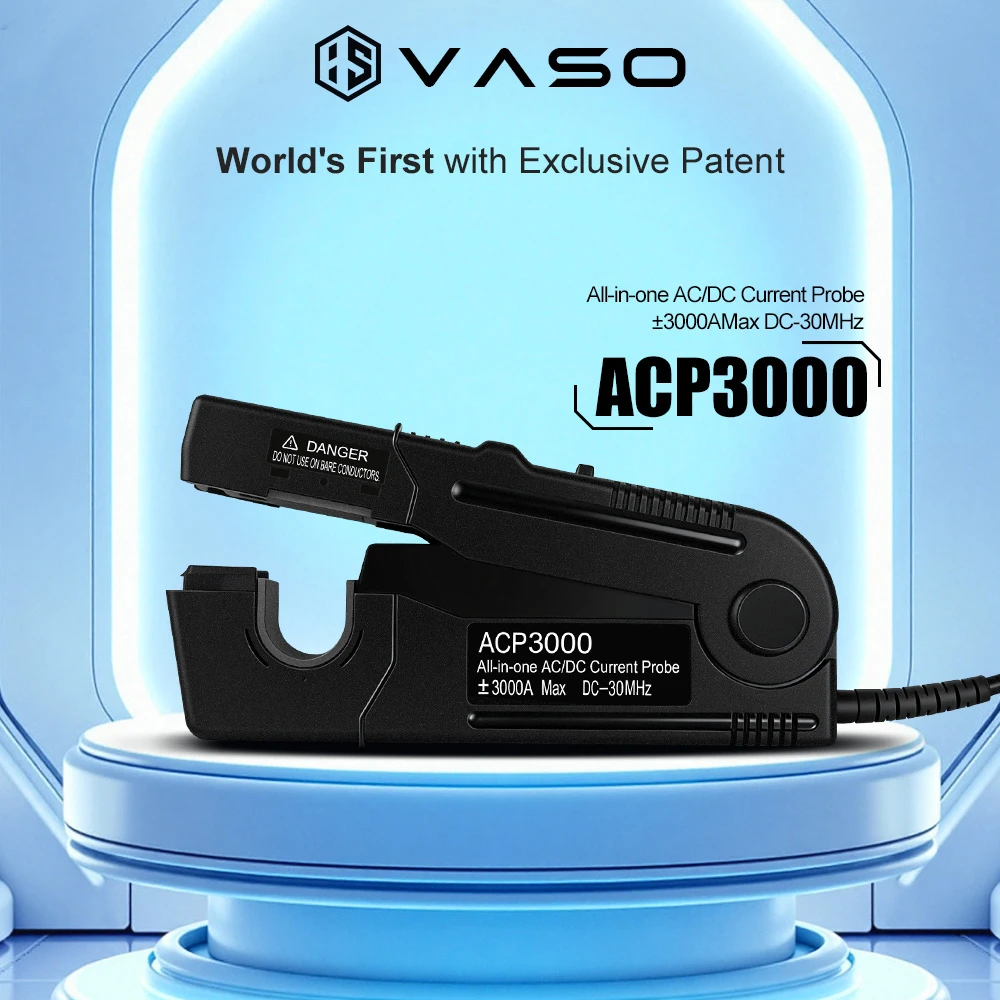
Top-tier ultra-high current range for large power systems.
Maintains true high bandwidth for high-current waveform observation.
Two current ranges matched to 100X and 1000X attenuation.
Large conductor capacity for high-current cables and bus-related testing.
Read and Follow Every Safety Requirement Before Operation
Thank you for purchasing this product. To use ACP3000 safely, read the manual carefully before operation. These safety instructions are intended to avoid personal injury and prevent damage to this product or any connected equipment. The manufacturer shall not be liable for personal injury or product damage caused by failure to follow these safety instructions.
Bare Conductor Voltage
Do not clamp around bare conductors with voltage exceeding 36V.
Power Disconnection
Disconnect power from the circuit under test before connecting or disconnecting the current probe.
Oscilloscope Grounding
The current probe is grounded indirectly through the oscilloscope. To avoid electric shock, ensure the oscilloscope is properly grounded.
Rated Voltage
Do not connect the current probe to any conductors exceeding the rated voltage.
Adapter Matching
This product is designed to be powered directly by an oscilloscope. When connecting to an oscilloscope, ensure the adapter matches the oscilloscope; mismatching may damage the product.
Adapter Pin Inspection
Before installing the adapter, check that the pins on the adapter circuit board are not bent or deformed. Excessive resistance during installation may indicate bent pins; forced installation may damage the probe socket.
Adapter Removal
Pull out the adapter evenly and straightly to avoid deforming the pins on the adapter circuit board.
Wet or Damp Environments
Do not operate in wet or damp environments.
Flammable or Explosive Environments
Do not operate in flammable or explosive environments.
Qualified Repair
Only qualified personnel are allowed to repair this product.
Patented Connector, Rugged Sensor and Simplified High-Current Setup
ACP3000 adopts a patented connector design that can be directly powered by compatible oscilloscopes and can automatically set the probe attenuation ratio. Compared with conventional current probes that require external power adapters and manual attenuation settings, ACP3000 greatly simplifies test wiring and setup.
Exclusive Patented Design
The patented connector supports oscilloscope direct power and automatic attenuation-ratio setup on compatible platforms.
Replace Adapter, Keep Probe
When switching oscilloscope platforms, users only need to replace the adapter to match the new oscilloscope, maximizing protection of the test investment.
Sturdy and Durable
The new-architecture sensor design solves the industry pain point that traditional high-frequency current sensors are easy to damage.
-40°C to +85°C
The unit breaks the limitation of traditional high-frequency AC/DC current probes that commonly operate only from 0°C to +50°C.
Extremely Low Insertion Impedance
Extremely low insertion impedance prevents sensor heating and supports stable long-duration measurement.
Long-Term High-Current Support
ACP3000 supports long-term high-current testing for high-power validation and laboratory environments.
No Current Frequency Derating
High-frequency testing does not require current frequency derating, preserving test capability under demanding conditions.
High Bandwidth and High Current
The ACP series can be customized for high-bandwidth and high-current scenarios according to user requirements.
Compatible from 1st to 3rd Generation Interfaces
Mainstream oscilloscope interfaces can be understood in three generations. The 1st-generation interface only provides the basic signal connection. The 2nd-generation interface adds a metal ring around the BNC connector to automatically set the probe attenuation ratio. The 3rd-generation interface adds power-supply and communication contacts on top of the 2nd generation, greatly improving probe convenience.
This patented design adopts interchangeable adapters and is compatible with all oscilloscope interfaces from the 1st generation to the 3rd generation.

| Oscilloscope Interface | Auto Probe Attenuation | Oscilloscope Direct Power | Required Setup and Remark |
|---|---|---|---|
| 1st Generation | No | No | Manually set the attenuation ratio and power the probe through a Type-C cable. |
| 2nd Generation | Yes, depending on oscilloscope support | No | Power the probe through a Type-C cable. Automatic probe attenuation-ratio setting is available on some oscilloscope brands. |
| 3rd Generation | Yes | Yes | Install the replaceable adapter to enable direct oscilloscope power and automatic attenuation-ratio setting. The interface approach is expandable to match different manufacturers. |
Replaceable Adapter, Offset Control and 100X / 1000X Range Operation
The ACP3000 body integrates a replaceable adapter, unlock handle, range indicator, offset adjustment wheel and GAIN range switch. These controls support compatibility, zeroing and range selection during high-current testing.

Adapter and Control Details
The replaceable adapter is used to match 3rd-generation interfaces of different oscilloscope brands. When using the adapter, ACP3000 can be powered directly by the oscilloscope and automatically set the attenuation ratio. Due to design limitations of some oscilloscopes, the current unit "A" may not display in auto mode. To show the unit, remove the pin corresponding to the metal ring around the BNC and set the attenuation ratio manually. Reinstall the pin to restore auto mode.

Complete ACP3000 Specification Matrix
This table restores the full ACP3000 specification set from the document, including current range, bandwidth, rise time, accuracy, attenuation, sensitivity, conductor capacity, safety voltage category, power supply, operating durability and physical dimensions.
| Parameter | ACP3000 Value | Engineering Meaning |
|---|---|---|
| Maximum Current | ±3,000A | Ultra-high-current capability for large power conversion, grid-level and high-power validation scenarios. |
| Bandwidth | DC–30MHz | True wide bandwidth for high-current waveform observation. |
| Rise Time | ≤11.7ns | Supports capture of fast transient behavior in high-current systems. |
| Accuracy | ±1% typical; ±3% warranty | Provides reliable measurement accuracy under stated product conditions. |
| Max Current, Low / High Range | 500A / 3000A | Offers a lower range for currents below 500A and a high range for ultra-high-current tests. |
| Attenuation Ratio | 100X / 1000X | Matches the 500A and 3000A ranges and oscilloscope setup requirements. |
| Minimum Sensitivity | 0.1A / 1A | Defines the minimum current sensitivity for the two ranges. |
| Max Conductor Diameter | 20mm | Accommodates large conductors used in high-current systems. |
| Max Bare Conductor Voltage | 600V RMS CAT II; 300V RMS CAT III | States the rated voltage category for bare conductor measurement conditions. |
| Power Supply | Oscilloscope powered / USB Type-C powered | Supports both direct oscilloscope power on compatible interfaces and USB Type-C power. |
| Attenuation Setting | Automatic, oscilloscope dependent | Automatic setup depends on oscilloscope interface and support. |
| Long-Term High-Current Test | Supported | Designed for sustained high-current measurement. |
| Current Frequency Derating | Not required | High-frequency measurement does not require current derating. |
| Sensor | Extremely stable, rugged | New architecture sensor design improves durability. |
| Operating Temperature | -40°C to +85°C | Wide temperature operation for harsh environments. |
| Dust Resistance | Yes | Suitable for high-dust testing environments. |
| Vibration Resistance | Yes | Suitable for high-vibration testing environments. |
| Cable Length | 2 meters | Provides practical connection length for bench and field use. |
| Probe Head Dimensions | L17.8cm × W2.8cm × H6.8cm | Physical probe-head dimensions for installation and access planning. |
Power, Configure, Zero and Clamp Correctly for Reliable Measurement
ACP3000 operation begins with the correct oscilloscope interface mode, 1MΩ impedance and DC coupling. Proper range selection, warm-up, zeroing and conductor positioning are required for reliable high-current measurement.
Select Power Mode and Scope Settings
Select the power supply mode according to the oscilloscope interface. Set the oscilloscope impedance to 1MΩ and set coupling to DC coupling.
3rd-Generation Interface
Use the replaceable adapter. This allows direct power supply from the oscilloscope and automatic attenuation-ratio setting, providing the most convenient operation.
2nd-Generation Interface
Remove the replaceable adapter while keeping the pin on the unlock handle. Automatic probe attenuation-ratio setting is available on some oscilloscope brands. Power is supplied through a USB Type-C cable from the oscilloscope USB port or from an external USB-A adapter.
1st-Generation Interface
The probe attenuation ratio can only be set manually. Power is supplied through a USB Type-C cable from the oscilloscope USB port or from an external USB-A adapter.
Select the Appropriate Range
Select the appropriate range according to the magnitude of the measured current. For currents below 500A, the 100X range is recommended for optimal performance.
Warm Up and Zero
After sufficient warm-up of the probe, approximately 2 minutes with 10 minutes recommended, adjust the zero point using the OFFSET wheel before testing.
Clamp and Measure
Open the clamp, secure the conductor under test and close the clamp to perform the measurement. The maximum conductor diameter must not exceed 20mm.
Center Thin Conductors
If the measured conductor is thin, try to position it at the center of the clamp to achieve the highest measurement accuracy.
Service Terms, Common Checks and Delivered Accessories
The probe carries a one-year factory warranty from the date of manufacture. Free repair is provided for non-human-induced damage and unopened units. The troubleshooting and package information below restores the complete document content.
Range Indicator Does Not Light Up
Check adapter-to-oscilloscope matching, the power adapter and the Type-C cable.
Auto Attenuation Ratio Is Incorrect
Oscilloscope auto-detection mismatch may occur. Remove the metal ring pin and set attenuation manually.
Incorrect Measurement Value
Ensure that the oscilloscope is set to 1MΩ impedance and DC coupling. A 50Ω impedance setting will cause large errors.
One-Year Factory Warranty
ACP3000 carries a one-year factory warranty from the date of manufacture, with free repair for non-human-induced damage and unopened units.
| Package Item | Quantity | Purpose |
|---|---|---|
| Probe Body | 1 pc | Main ACP3000 current probe body. |
| High-Quality Type-C Cable | 1 pc | USB Type-C power supply cable for applicable interface modes. |
| Product Manual | 1 pc | Operating, safety and product information reference. |
| Test Report | 1 sheet | Product test documentation. |
| Warranty Card | 1 pc | Warranty registration and service support document. |
| Portable Carrying Case | 1 pc | Storage and transport protection. |
Compatibility, Industry Pain Points and Current Probe Selection Rules
The ACP series is designed around proprietary replaceable adapter technology and rugged high-frequency current sensing. Selection should balance bandwidth, current rating, measurement accuracy, jaw opening diameter and operating environmental conditions.
Which Oscilloscopes Are Compatible?
Featuring a replaceable adapter design with proprietary technology, this product is fully compatible with all oscilloscope interfaces from the 1st generation to the 3rd generation.
What Are the ACP Series Features?
The exclusive patented connector design allows direct oscilloscope power and supports automatic attenuation-ratio configuration. It simplifies test wiring and streamlines measurement setup compared with conventional current probes requiring external power adapters and manual attenuation setting.
What Pain Points Are Solved?
The new-generation structural sensor design is robust and durable, solving the common industry issue of fragile traditional high-frequency current sensors. The -40°C to +85°C operating range, extremely low insertion impedance, no sensor overheating, long-duration high-current testing and no frequency derating all improve usability.
How Does Adapter Replacement Help?
When switching to a different oscilloscope platform, only a simple adapter replacement is needed for compatibility, effectively maximizing and protecting the user's test investment.
Use 3–5× Signal Frequency
The core bandwidth selection principle is that probe bandwidth should be 3 to 5 times the maximum frequency of the measured signal.
Higher Is Not Always Better
Bandwidth selection should combine rise time, oscilloscope matching, noise performance and current range. Higher bandwidth does not always mean better performance.
Probe and Scope Work Together
The overall measurement-system bandwidth is determined by the lower bandwidth value between the probe and the oscilloscope.
Match Probe to Scope Bandwidth
It is recommended that probe bandwidth reaches at least 80% of oscilloscope bandwidth. For example, a 500MHz oscilloscope requires a probe with at least 400MHz bandwidth.
Recognize the Trade-off
High-bandwidth probes of 100MHz and above generally have small current ranges of ≤50A. High-current probes of ≥100A are usually limited to lower bandwidth of ≤50MHz.
Cover Peak Current by 20%–30%
The selected current range should provide sufficient bandwidth and cover the measured peak current with a 20%–30% margin.
Avoid Excess Bandwidth at Low Frequency
For low-frequency applications such as 1kHz, a 10MHz bandwidth probe is sufficient to avoid RF noise introduced by excessive high bandwidth.
Prioritize Flatness and Resonance Control
For high-frequency applications, prioritize probes with excellent frequency flatness within ±1dB and resonance peaks outside the working frequency band.
Designed for Megawatt-Level, Grid-Level and Large-Bus Current Testing
ACP3000 provides top-tier ultra-high current capability of 3000A while maintaining true high bandwidth of 30MHz. It is specifically designed for megawatt-level, grid-level and large-bus applications where both current capacity and waveform fidelity are required.
Flexible DC MMCs for Power Grids
Suitable for high-current modular multilevel converter and power-grid module testing.
Converter Valves
Supports large-current waveform measurement in converter-valve systems.
Power Grid Short-Circuit Testing
Provides ultra-high-current measurement capability for grid short-circuit tests.
Type Testing Laboratories
Suitable for formal high-power type-test validation environments.
Large Energy Storage Busbars
Supports measurement of large 3000A busbar current in containerized energy storage systems.
Ship Integrated Electric Propulsion
Applicable to ship propulsion power systems with high current and large power levels.
Aerospace Power Systems
Supports high-current validation needs in aerospace power systems.
High-Voltage DC Power Grids
Applicable to HVDC-related high-current testing and validation.
Electrolytic Aluminum and Hydrogen Production
Fits high-current industrial power and electrochemical process power systems.
High-Power Rectifier Power Supplies
Suitable for rectifier output and large power-supply current testing.
Pulse Power
Supports high-current pulse power observation and testing.
Laser Power Supplies
Applicable to high-power laser power-supply current measurement.
Electromagnetic Equipment
Suitable for electromagnetic equipment requiring large-current waveform capture.
