
PCS Current Probe for Energy Storage and Battery Inverter Testing
Measure bidirectional PCS current, battery inverter current and high-power conversion waveforms with stable AC/DC current probes built for long-duration testing.
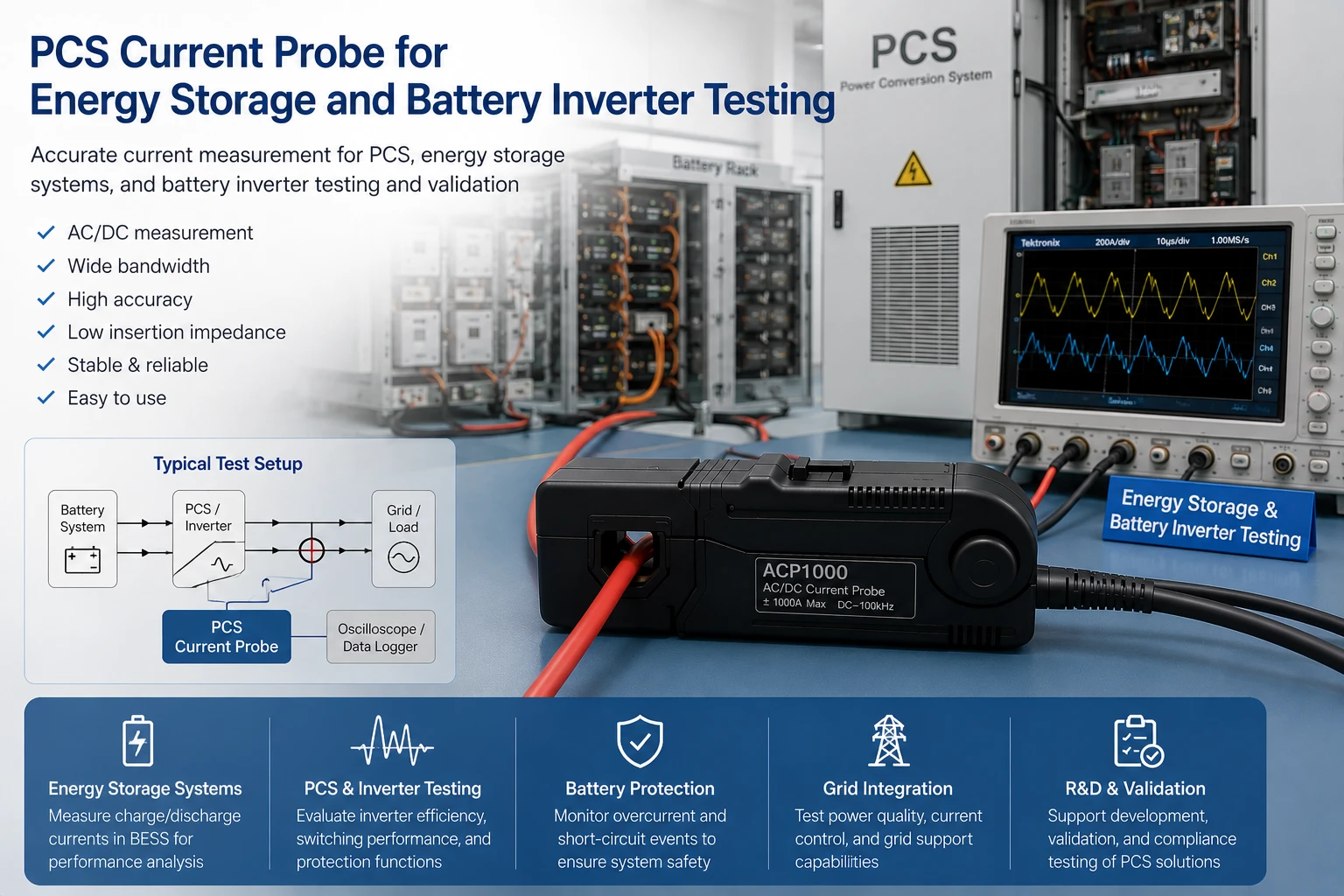
Energy storage PCS testing involves bidirectional power flow, high current levels and long test cycles. Measurement errors or probe overheating can delay validation and make waveform analysis unreliable.
Challenges in PCS & Energy Storage Testing
Energy storage PCS testing involves bidirectional power flow, high current levels and long test cycles. Measurement errors or probe overheating can delay validation and make waveform analysis unreliable.
Bidirectional Current
Large DC bus and battery-side current during charge and discharge tests.
Grid-Tied & Off-Grid Modes
Bidirectional inverter current waveforms under grid-tied and off-grid operating modes.
Long-Duration Tests
Long-duration current measurement during thermal, aging and endurance tests.
Switching Ripple Capture
Need to capture switching ripple and transient events, not only RMS current.
Thermal Tolerance
Limited tolerance for probe heating, drift or frequency derating in high-current tests.
Validation Delays
Measurement errors can delay validation and make waveform analysis unreliable.
How ACP Probes Help
ACP series probes provide non-invasive AC/DC current measurement for high-power conversion systems. They help PCS engineers observe current behavior without breaking the conductor path, while preserving waveform details for debugging, efficiency analysis and protection validation.
Full-System Coverage
Capturing battery-side, DC bus and inverter-side current waveforms.
High Current Range
Supporting high current testing from ±1000A to ±3000A.
Wide Bandwidth
Providing bandwidth up to DC–40MHz with ACP1000 and DC–30MHz with ACP3000.
No Frequency Derating
Supporting long-term maximum current tests without frequency derating based on product data.
Simplified Wiring
Simplifying bench wiring through oscilloscope direct power supply or USB Type-C supply.
Stable Sensor
Highly stable sensor structure that is difficult to damage.
Choose the Right PCS Probe
ACP1000 is the first choice for most PCS and battery inverter tests. ACP3000 is recommended when the measurement point can exceed 1000A or when testing large cabinet-level systems.
Typical Test Scenarios
- Battery-side charge and discharge current measurement
- PCS DC bus current waveform capture
- Grid-tied inverter output current validation
- Bidirectional converter transient response testing
- Energy storage cabinet thermal and aging tests
- Protection logic verification during overcurrent or short-time surge events
- Ripple current analysis for filter, capacitor and inductor evaluation
Parameters and Advantages
| Capability | ACP Series Advantage |
|---|---|
| Current range | ACP1000: ±1000A; ACP3000: ±3000A |
| Bandwidth | ACP1000: DC–40MHz; ACP3000: DC–30MHz |
| Accuracy | ±1% typical value, ±3% warranty value based on internal product data |
| Power supply | Oscilloscope direct supply or USB Type-C supply |
| Long-term testing | Supports long-term maximum current test based on product data |
| Frequency derating | No maximum current frequency derating based on product data |
| Operating temperature | −40°C to +85°C |
| Sensor structure | Highly stable and difficult to damage |
No Maximum Current Frequency Derating
Unlike many high-current probes that must be derated at higher frequencies, ACP series probes support long-term maximum current tests without frequency derating — a critical advantage for energy storage endurance and thermal validation programs.
Frequently Asked Questions
Which current probe is suitable for PCS testing?
ACP1000 is suitable for most PCS module and battery inverter testing. ACP3000 is recommended for large current buses, container-level energy storage and high-current validation.
Can ACP probes be used for bidirectional current measurement?
Yes. ACP probes are designed for AC/DC current measurement, making them suitable for charge and discharge current, inverter current and pulse current in bidirectional PCS systems.
Why is bandwidth important in PCS current measurement?
Bandwidth affects how accurately the probe captures ripple, switching components and transient events. For PCS debugging, both current range and bandwidth should be considered together.
Can ACP probes support long-duration tests?
Yes. Product data indicates ACP series probes support long-term maximum current testing without maximum current frequency derating.
Can the probe jaw or cable be customized for cabinets?
Yes. Customized versions can adjust jaw size, cable length, current range, bandwidth and protection requirements based on cabinet or busbar constraints.
Ready to Test Your PCS or Energy Storage System?
Contact VASO today to discuss your energy storage PCS testing requirements. We'll help you select the right ACP probe for charge/discharge, inverter and endurance testing.