

If you’ve ever tried to debug a switching power supply, a motor drive, or a battery charging circuit with a plain AC current probe, you’ve probably run into a strange problem: the waveform looks wrong, the measurement drifts, or the numbers simply don’t match what a multimeter tells you. Nine times out of ten, the culprit isn’t your oscilloscope — it’s the probe.
Answer
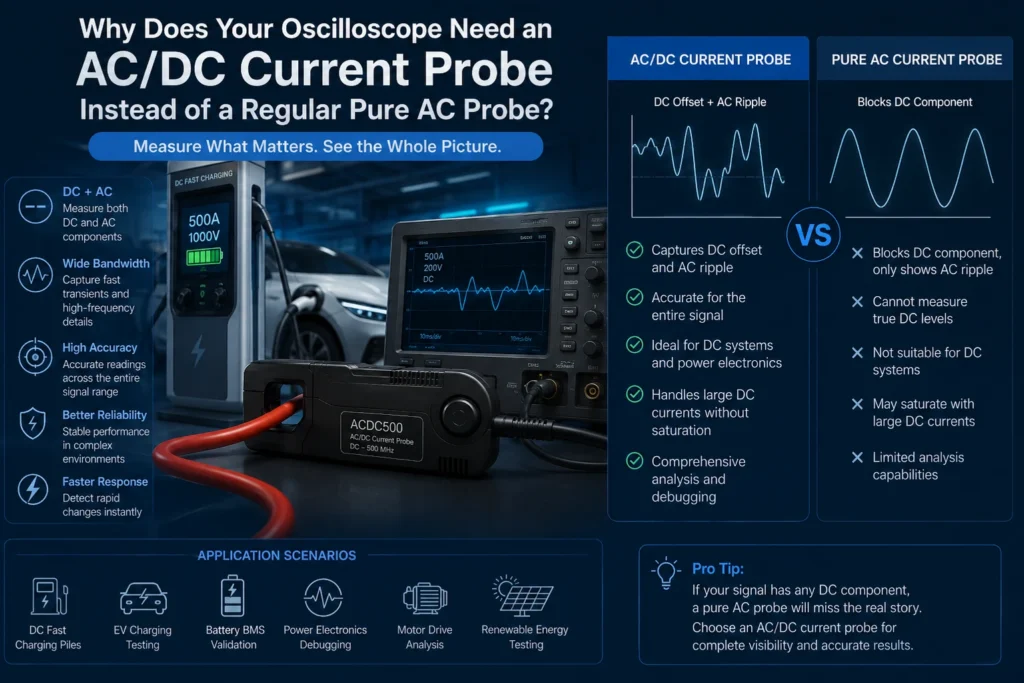
A pure AC current probe can only sense current that changes over time. It works by detecting the magnetic field a conductor produces, usually through a current transformer (CT) built around a split core. A transformer, by its very nature, cannot pass a steady, unchanging magnetic field to its secondary winding — no change in flux means no induced voltage, which means no signal. So the moment your current has a DC component, an AC-only probe simply drops it. You end up seeing only the ripple, not the real current.
An AC/DC current probe fixes this by adding a second sensing element — typically a Hall-effect sensor — that responds to the absolute strength of a magnetic field, not just its rate of change. The Hall sensor handles the DC and low-frequency content, while the transformer stage handles the higher-frequency AC content. Combine the two, and you get a single measurement that’s accurate from 0 Hz up to several megahertz.
Where a Pure AC Probe Falls Short
Most modern circuits don’t produce clean, symmetrical AC current. Consider a few common examples:
- Switch-mode power supplies draw current in pulses that ride on top of a DC average.
- Motor drives often push asymmetric current through the windings, especially during startup or stall conditions.
- Battery charge/discharge circuits are, by definition, mostly DC with some AC noise superimposed.
- Class D amplifiers and inverters generate high-frequency switching current layered over a slower DC or low-frequency signal.
In every one of these cases, an AC-only probe will report an incomplete picture. Worse, because the missing DC offset shifts the entire waveform, you can misinterpret peak values, RMS values, and even the shape of the ripple itself. Engineers who don’t realize this limitation sometimes chase phantom problems for hours, when the real issue is that their probe is filtering out exactly the information they need.
How the Two Probe Types Actually Differ
| Pure AC (transformer-only) probe | AC/DC (Hall-effect + transformer) probe | |
|---|---|---|
| Senses DC current | No | Yes |
| Frequency range | Typically a few Hz to tens of MHz | 0 Hz (true DC) to several MHz |
| Sensing technology | Current transformer only | Hall-effect sensor + current transformer |
| Needs external power | Usually no | Yes, almost always |
| Typical use cases | Simple AC line measurements, RF current | Power electronics, motor drives, battery systems, mixed AC/DC loads |
| Relative cost | Lower | Higher |
The tradeoff is straightforward: AC/DC probes cost more and require power (batteries or a bench supply) because the Hall sensor needs an active bias to operate. A pure AC transformer probe is passive and needs nothing but the loop of wire it clamps around. If your application really is pure AC — say, measuring mains current with no DC bias — the simpler probe is perfectly fine and often the more cost-effective choice.
Signs You Actually Need an AC/DC Probe
You likely need a wideband AC/DC current probe if any of the following apply to your measurement:
- The circuit under test includes a DC power rail, battery, or DC bus.
- You’re measuring current in a power converter, inverter, or motor controller.
- Your multimeter’s DC current reading doesn’t match your oscilloscope’s “AC” reading, even roughly.
- The waveform on your scope looks clipped at the bottom, or seems to hover strangely close to zero when you know current is flowing continuously.
- You need accurate RMS or average current values for efficiency or thermal calculations — DC content that’s silently dropped will throw those numbers off.
A Quick Way to Check Your Probe
Most probe manufacturers list a bandwidth spec that starts either at “DC” or at some nonzero frequency, like 5 Hz or 10 Hz. If the low end of that spec isn’t literally “DC,” the probe is AC-coupled and will not capture a steady current. This single line in the datasheet tells you everything you need to know before you even plug the probe in.
Final
A pure AC current probe measures only the changing part of a signal, because its transformer-based sensing physically cannot pass DC. An AC/DC current probe adds Hall-effect sensing to capture the DC component too, giving you the full current waveform from zero frequency up through the switching harmonics. For anything involving batteries, DC buses, motor drives, or power conversion, the AC/DC probe isn’t a luxury — it’s the only way to see the whole signal instead of half of it.