

Ask ten engineers how they measure current and you’ll get at least three answers, usually delivered with a fair amount of conviction. The shunt crowd swears by simplicity. The Rogowski people love that they can slip a coil around a fat busbar without shutting anything down. And the probe users just want to clamp on, hit auto-scale, and see both the DC bias and the switching ripple on the same trace.
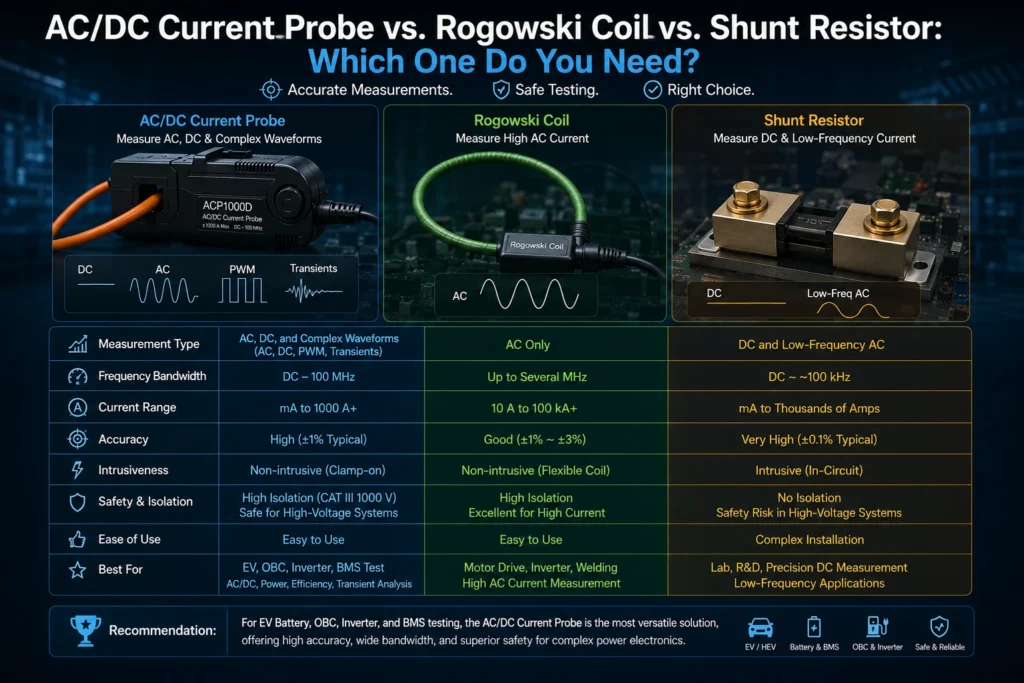
They’re all right, sort of. The honest answer is that no single method wins every bench. What matters is matching the sensor to the signal you’re chasing and the risk you’re willing to take with your circuit. Below is how the three stack up on the four things that actually decide the outcome — bandwidth, size, insertion loss, and cost — followed by a plain recommendation on when each one earns its place.
The three contenders in one paragraph each
Shunt resistor. You put a known, low-value resistor in series with the load and measure the voltage across it. Ohm’s law does the rest. It’s the oldest trick in the book and, for good reason, still everywhere.
Rogowski coil. An air-cored coil wraps around the conductor and picks up the rate of change of current (di/dt). An integrator turns that back into a current waveform. No iron core means nothing to saturate, and the loop is thin and flexible.
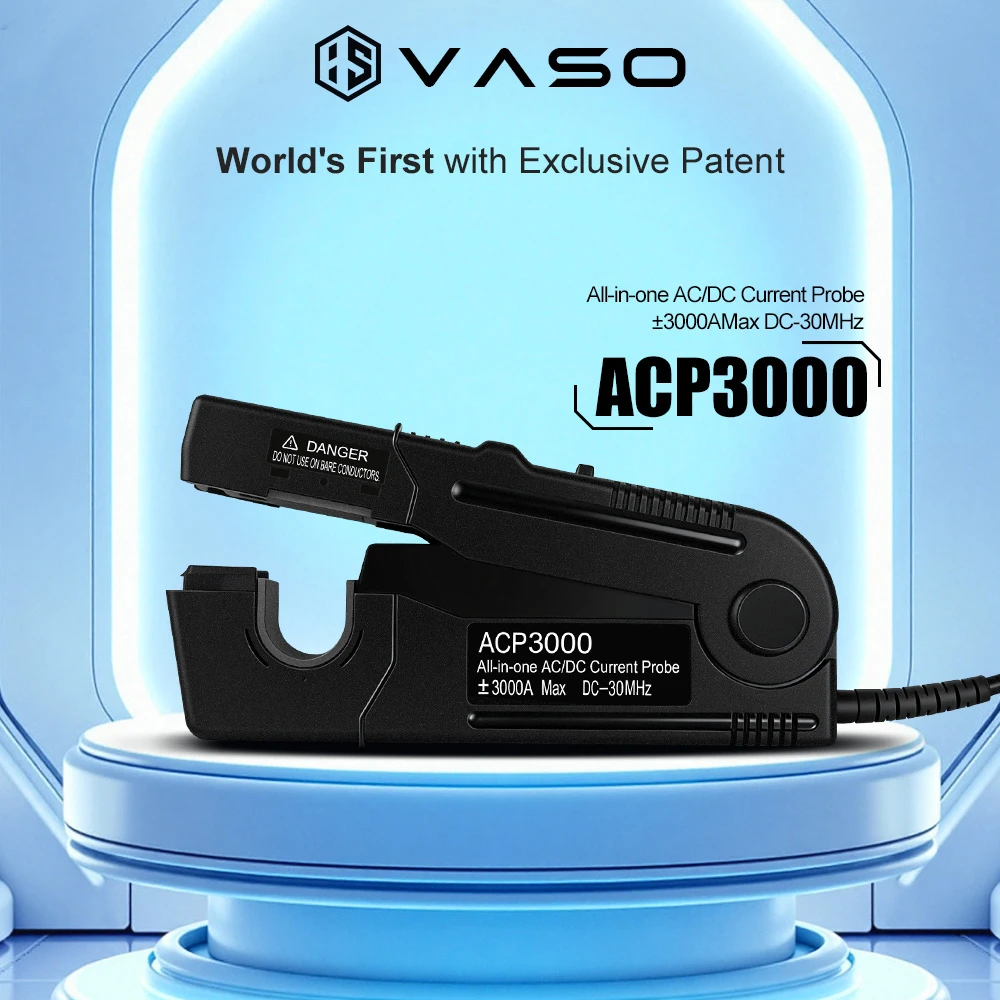
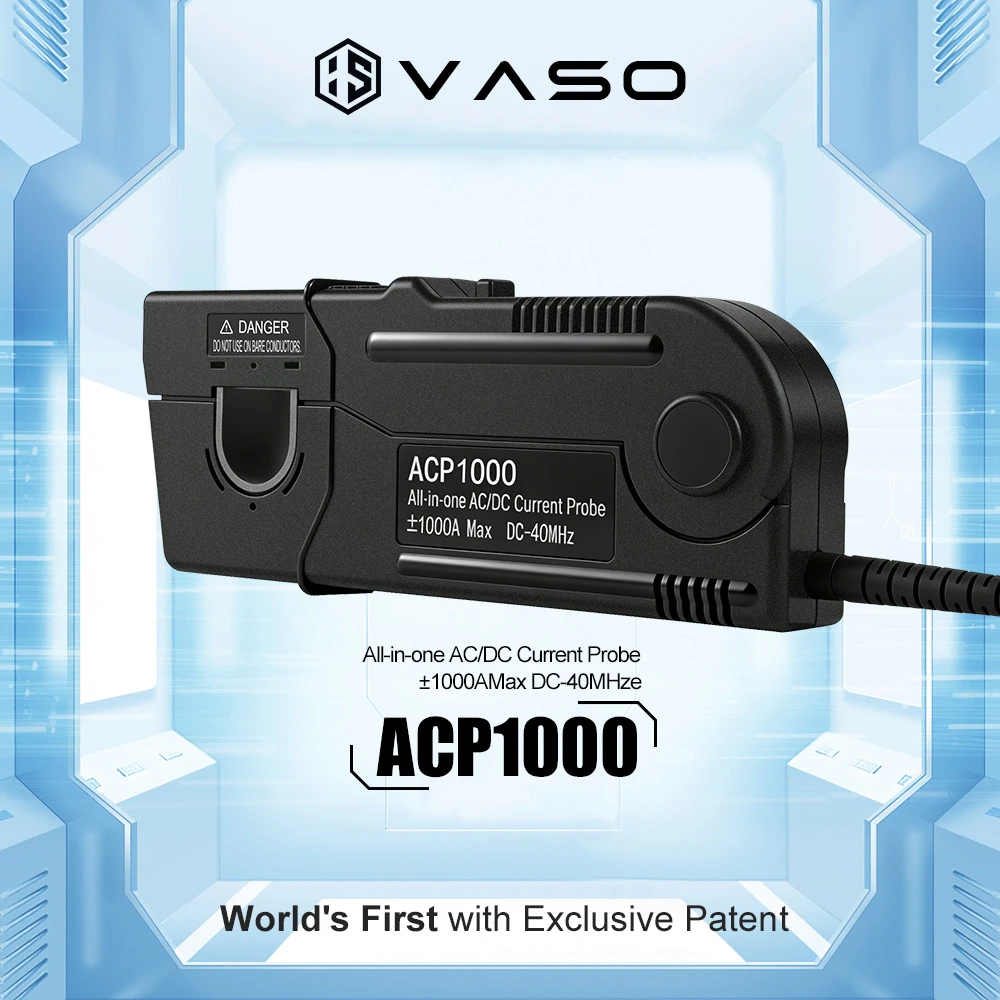
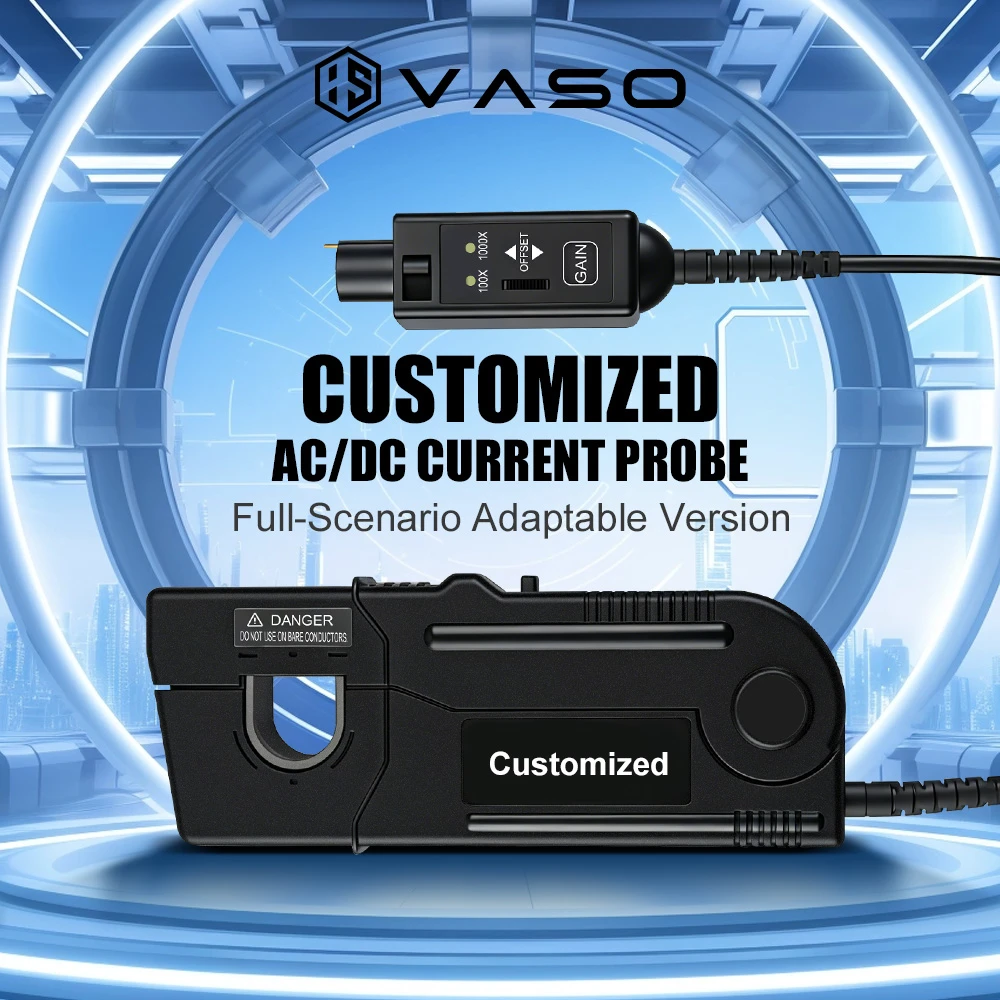
AC/DC current probe. A clamp-style head combines a Hall-effect (or fluxgate) sensor for the DC and low-frequency content with a current-transformer winding for the high-frequency content. The two paths are blended internally so you get one continuous measurement from DC all the way up. You never break the circuit — you clamp around it.
Bandwidth: what can you actually see?
This is where the field separates fastest.
A shunt has, on paper, the widest theoretical reach — a well-designed coaxial current shunt can push into the hundreds of MHz and beyond, and it reads true DC with no drift. That’s a genuinely enormous span. The catch is the word “well-designed.” The moment you use an ordinary chip or PCB shunt, parasitic inductance in the resistor body and the layout starts adding a nasty rising response and ringing well before you reach those numbers. Getting clean wideband performance out of a shunt is a layout discipline problem, not a buy-it-and-go problem.
A Rogowski coil is fundamentally an AC-only device. Because it responds to di/dt, a steady DC current produces no output at all — there’s simply nothing changing for it to sense. So if your signal has a DC component (and in power electronics it almost always does), the Rogowski just can’t see that part. Where it shines is the AC side: the high-frequency ceiling can reach into the tens of MHz, which is more than enough to catch fast IGBT and SiC switching edges. But the low end sags — very slow AC gets attenuated, and integrator drift becomes the limiting factor down there.
An AC/DC current probe is built specifically to cover the gap that trips up the other two. The Hall/fluxgate path handles DC and the slow stuff; the transformer path handles the fast stuff; the crossover is stitched together so you read one uninterrupted waveform. Good hybrid probes routinely span DC up to tens of MHz, and high-end heads reach much higher. The practical payoff: when you’re staring at a switching-converter node that has a DC load current and megahertz ripple riding on top, the probe shows you both at once. The Rogowski would drop the DC floor; the shunt would need heroics to stay clean.
Bottom line on bandwidth: the shunt has the highest ceiling if you engineer it perfectly and don’t need isolation. The Rogowski is fast but blind to DC. The current probe is the only one of the three that gives you honest DC-to-fast-AC coverage straight out of the box.
Size and mechanical fit: can it even go where you need it?
Bench specs mean nothing if the sensor won’t fit around the wire.
The Rogowski coil is the clear winner on brute mechanical access. It’s thin, flexible, and often clips open, so you can loop it around a chunky busbar, a tangle of cables, or a device pin buried inside a crowded inverter — no core to fight, no fixed jaw size. For very high currents and awkward geometries, nothing else comes close. It’s also light, which matters when it dangles off a device lead you don’t want to stress.
An AC/DC current probe carries a physical clamp head, and that head has real bulk. The jaw sets the maximum conductor diameter it’ll swallow, and on high-current heads that jaw gets heavy. On a dense board with components packed shoulder to shoulder, finding a clear length of conductor to clamp can be the whole battle. That said, the head is still non-intrusive — you’re clamping, not soldering.
A shunt is tiny at low current — a surface-mount part you’d barely notice. But size scales brutally with power. Push serious amps through it and you’re now dealing with a big metal element bolted to a heatsink, because it has to dissipate the heat it generates. So “small” is only true at the low end of the current range.
Insertion loss: what does the sensor do to your circuit?
This one gets underrated until it bites you, and it’s the strongest argument in the whole comparison.
A shunt is intrusive by definition. You have to break the circuit and put the resistor in the current path. That does three things you’d rather avoid. First, it adds series resistance — the “burden voltage” — which drops the voltage your actual load sees and can genuinely change how the circuit behaves, especially in low-voltage or high-current rails. Second, it dissipates power as I²R, which is wasted energy and, worse, a heat source. Third, that heat drifts the resistor’s value and generates thermal EMF at the junctions, quietly corrupting the very measurement you’re trying to make. You can fight all of this with Kelvin sensing, low-TCR alloys, and careful thermal design — but you’re fighting.
Oh, and the shunt is not galvanically isolated. It sits at the circuit’s potential. To get that signal safely into an oscilloscope referenced to earth, you need an isolated amplifier or a differential front end — extra cost, extra bandwidth compromise, extra failure modes.
A Rogowski coil is essentially insertion-free. There’s no core, so it presents almost no burden to the conductor and draws virtually no energy from it. It’s also fully isolated by nature — just a coil in a magnetic field. This is exactly why it’s a favorite for clamping onto high-power, high-voltage systems that you cannot, under any circumstances, interrupt or make direct contact with.
An AC/DC current probe is likewise non-intrusive and isolated. You clamp it around the conductor and the circuit barely knows it’s there — the loading is negligible for the vast majority of measurements. You get the safety of isolation and the convenience of never having to cut a trace, resize a resistor, or worry about burning up a sense element. On a live system, that’s not a luxury; it’s how you keep both your DUT and your instrument intact.
Bottom line on insertion loss: the shunt is the only one of the three that physically interferes with the circuit and lacks native isolation. The Rogowski and the current probe both leave the circuit essentially untouched — and both keep you galvanically separated from whatever nasty potentials are floating around in a power stage.
Cost: cheap to buy isn’t the same as cheap to use
Here’s where a lot of decisions go wrong, because people compare the sticker and stop there.
The shunt wins on raw component cost — a basic sense resistor is about as cheap as test hardware gets. But the total cost is deceptive. Add the isolated amplifier, the precision alloy for stability, the thermal design and heatsinking for anything above modest current, and the engineering time to lay it out so it doesn’t ring at high frequency, and the “cheap” option stops looking so cheap. It’s inexpensive when the job is small and permanent; it gets expensive when the job is demanding.
A Rogowski coil lands in the middle. The coil itself is reasonably priced even in large sizes, and the fact that one flexible loop can cover an enormous current range without swapping hardware gives it real value on high-current work. You do pay for the integrator electronics, and precision AC-only measurement has its own calibration overhead.
An AC/DC current probe is the biggest up-front spend of the three — no way around it. You’re paying for the Hall/fluxgate sensor, the transformer path, the blending electronics, the calibration, and the mechanical clamp. But look at what that one purchase replaces: it does the shunt’s DC job and the Rogowski’s fast-AC job, with isolation built in and zero circuit surgery. One instrument, clamp on, both DC and AC, no burden voltage, no broken traces, no heatsink. For a lab that measures a variety of circuits, the probe’s cost-per-measurement over its life is often the lowest of the three, even though the receipt is the largest. You buy it once and stop improvising.
Side-by-side
| Shunt Resistor | Rogowski Coil | AC/DC Current Probe | |
|---|---|---|---|
| DC measurement | Yes | No (AC only) | Yes |
| Bandwidth | Very high if perfectly engineered; parasitics bite otherwise | High-frequency reach is strong; no low-frequency/DC floor | DC to fast AC, continuous, out of the box |
| Isolation | None (needs isolated amp) | Inherent | Inherent |
| Insertion loss / burden | Significant — burden voltage, I²R heat, thermal drift | Negligible | Negligible |
| Mechanical fit | Tiny at low current; bulky + heatsinked at high current | Thin, flexible, best for busbars & tight spots | Clamp head has bulk; jaw limits conductor size |
| Circuit surgery needed | Yes — break the circuit | No — loop around | No — clamp around |
| Up-front cost | Lowest | Middle | Highest |
| True cost in use | Rises fast with power & isolation needs | Moderate | Often lowest cost-per-measurement over its life |
So which one do you actually need?
Strip away the tribalism and it comes down to your signal and your tolerance for messing with the circuit.
Reach for a shunt when the measurement is permanent and embedded — think a fixed current-sense point inside a product, a battery management rail, or a motor-control feedback loop where the resistor lives on the board forever and cost-per-unit is king. It’s the right call when you own the layout, you can budget for the burden voltage, and you don’t need isolation. It’s the wrong call the moment you need to probe something quickly, safely, and without touching the circuit — which describes most bench work.
Reach for a Rogowski coil when the current is large, the conductor is awkward, and the signal is purely AC. High-power inverters, big busbars, cabling you can’t disconnect — the flexible loop and the total absence of insertion loss are hard to beat. Just remember its blind spot: no DC, and a weak low-frequency floor. If your waveform has a DC component, a Rogowski will lie to you by omission.
Reach for an AC/DC current probe when you want one tool that handles the widest range of real-world situations without forcing you to choose in advance. It’s the answer whenever you need to see DC and AC together — which is nearly every switching converter, motor drive, battery charger, and power supply on the planet. It’s the answer whenever the circuit must stay intact and isolated. And it’s the answer whenever you value the ability to clamp on, measure, and move to the next node without cutting a trace or sizing a resistor.
That last point is the quiet reason the current probe ends up on most serious power-electronics benches. The shunt makes you commit surgery to your circuit and gives up isolation. The Rogowski makes you commit to AC-only and hope there’s no DC hiding in your signal. The AC/DC current probe makes you commit to nothing — it reads what’s actually there, DC and AC alike, without loading the circuit or putting you in electrical contact with it.
If your work spans more than one type of measurement — and whose doesn’t — the probe is the sensor you grow into rather than out of. Buy the shunt for the product. Keep the Rogowski for the busbar. But if you’re equipping a bench that has to give you the truth about DC bias and switching behavior, on live circuits, without drama, the AC/DC current probe is the one that earns its keep every single day.