

Anyone who has priced a replacement current probe for a Tektronix or Keysight oscilloscope knows the frustration. The probe itself often costs a meaningful fraction of the scope, lead times stretch out for weeks when a unit is imported, and a single probe that needs a separate amplifier can turn one line item into three. For labs running power-electronics, motor-drive or battery test benches, that is a recurring budget headache — and it is exactly the gap the VASO ACP series of AC/DC current probes was built to close.
VASO is the current-probe brand of Huasu Zhike, a company focused solely on the R&D, production and calibration of current-detection solutions. Its ACP-series probes use integrated Hall-effect and transformer technology to capture AC, DC and pulse waveforms non-intrusively, and are already deployed across new energy vehicles, power systems, industrial automation, avionics and EMC testing.
The point of this comparison is not to claim a no-name clone matches a flagship. It is to put the numbers side by side, be honest about where the mainstream probes still lead, and show where a VASO probe delivers the same measurement job at a lower total cost — with interface compatibility, simpler powering and local calibration support that an imported probe cannot easily match.

The probes most labs are trying to replace
Two models come up again and again in replacement requests, so they make the natural reference points.
The Tektronix TCP305A is a split-core AC/DC probe rated for 50 A DC (35.4 A RMS), with a bandwidth of DC–50 MHz, sensitivity down to 5 mA and a rise time under 7 ns. It is a proven, accurate probe — but it does not work on its own. It requires a TCPA300 amplifier to function, which means a replacement decision is really a two-box decision, and the amplifier is the expensive half.
The Keysight N2783B takes a different route. It is a clamp-style hybrid probe (Hall sensor plus AC transformer) rated for 30 A RMS and 50 A peak, with a wider DC–100 MHz bandwidth, 5 mA sensitivity and a 10 mV/A output. It draws power from an external supply — the N2779A — which can feed up to three probes at once, but that supply is again a separate purchase.
Both are excellent instruments. Both also share the same three pain points: they are costly, they depend on a companion box, and when they need service or recalibration the unit typically leaves the country.
Where the VASO ACP series lines up
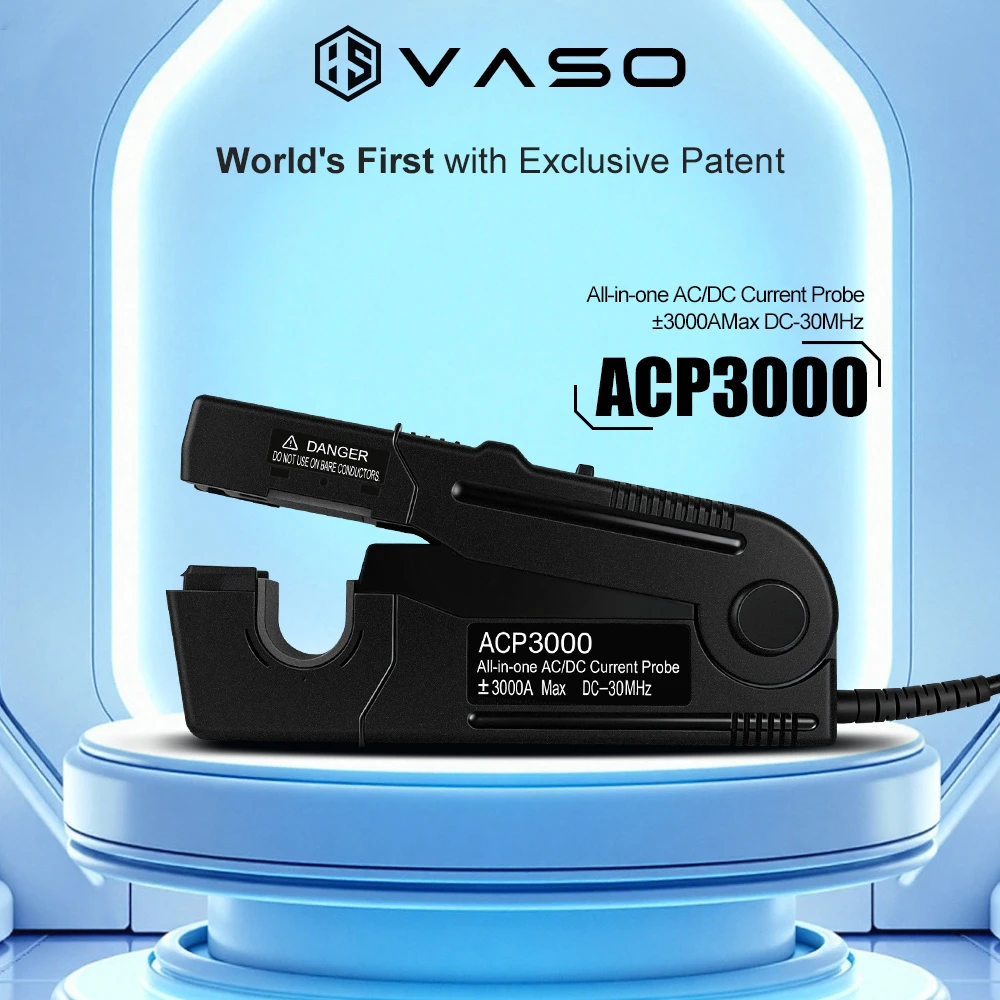
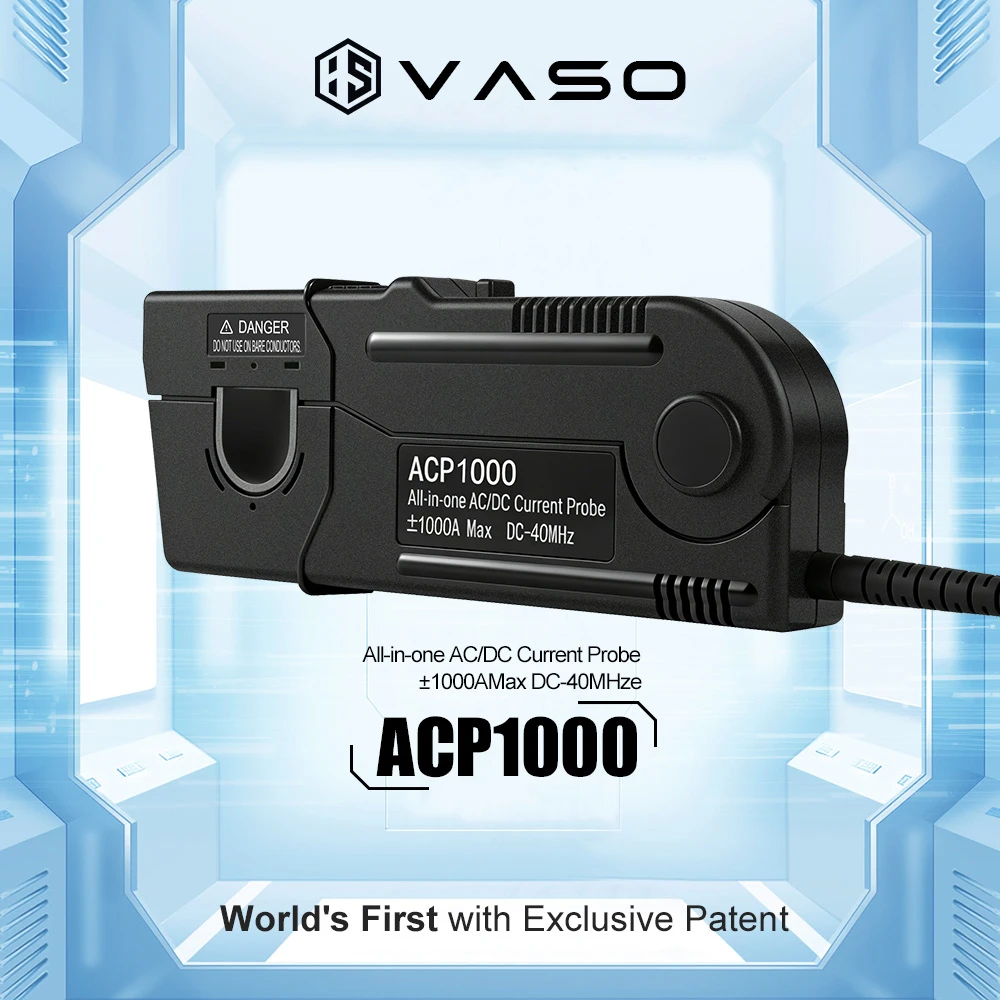
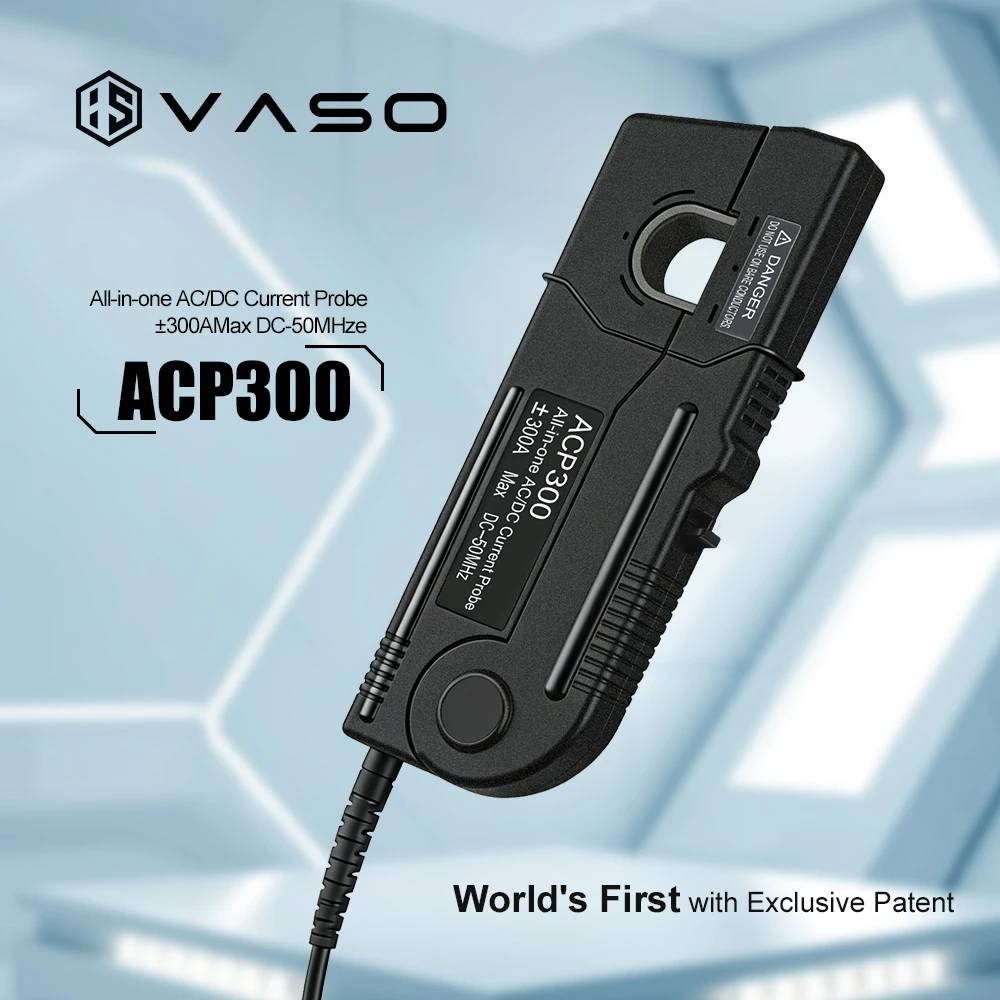
The VASO ACP probes are specified around the same measurement envelope that most bench and field work actually needs, and in raw current-handling they reach considerably higher. Three models cover the common cases:
| Specification | VASO ACP3000 | VASO ACP1000 | VASO ACP300 | Tektronix TCP305A | Keysight N2783B |
|---|---|---|---|---|---|
| Peak current | 3,000 A | 1,000 A | 300 A | 50 A (peak) | 50 A (peak) |
| Bandwidth | DC–100 MHz | DC–40 MHz | DC–50 MHz | DC–50 MHz | DC–100 MHz |
| Typical accuracy | 1% typical | 1% typical | 1% typical | — | — |
| Power supply | Oscilloscope-direct | Dual mode | Industrial grade | Requires TCPA300 amplifier | Requires N2779A supply |
Read the table the way a test engineer would. On bandwidth, the ACP3000 matches the N2783B at DC–100 MHz and beats the TCP305A’s 50 MHz ceiling — while the ACP1000 (40 MHz) and ACP300 (50 MHz) sit right in the band where switch-mode supplies, inverters and motor drives are measured. On current handling, the comparison is not close: where the mainstream probes top out around 50 A, the ACP range reaches 300 A, 1,000 A and 3,000 A, which opens up busbar, traction and industrial-drive work that the Tektronix and Keysight probes simply cannot clamp.
The one number the mainstream datasheets win on paper is low-end sensitivity — both list 5 mA minimums aimed at very low standby-current measurement. For labs whose job is milliamp-level standby profiling, that remains a genuine reason to keep a flagship probe on the bench. For the far more common task of measuring amps to kiloamps across a real power stage, the VASO probes cover the range with 1% typical accuracy.

Interface compatibility: drop-in, not re-engineer
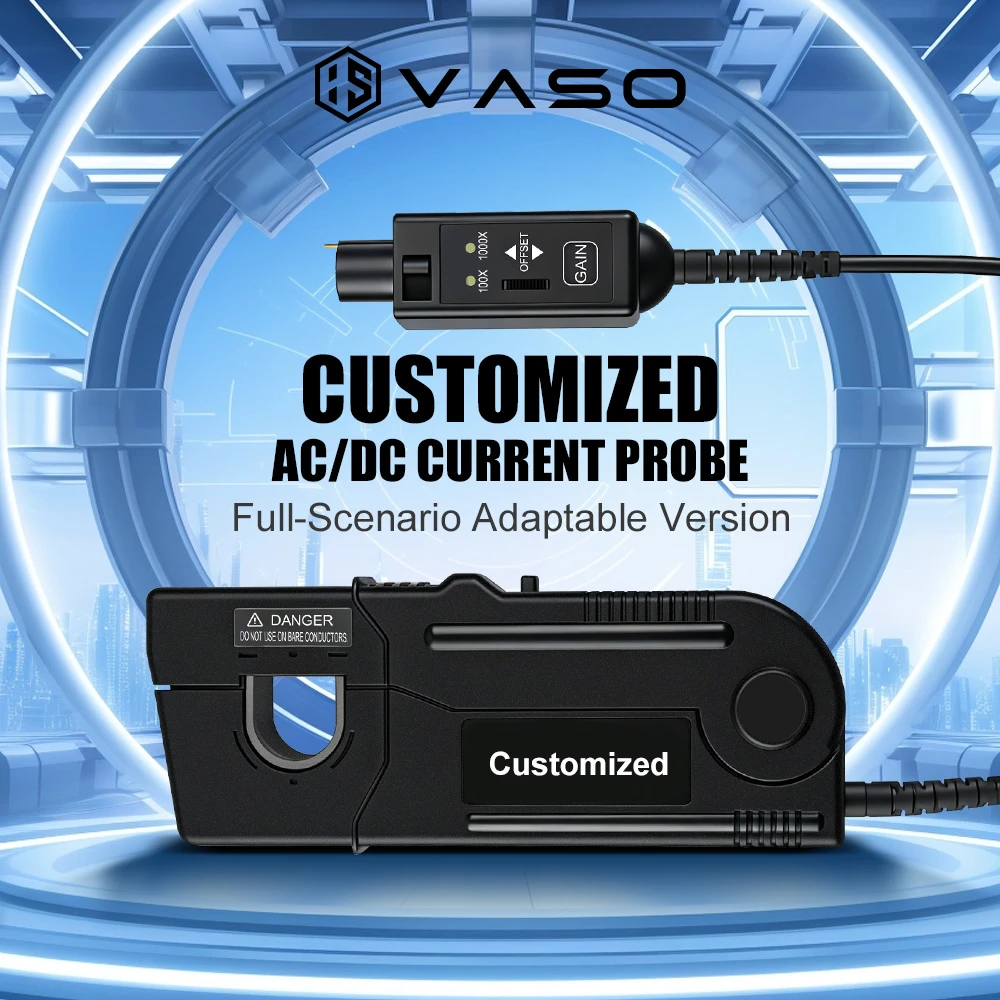
A replacement probe only saves money if it plugs into the scope already on the bench. The ACP series uses a replaceable-adapter design that VASO states is compatible with oscilloscope interfaces from the 1st through the 3rd generation — so an existing Tektronix, Keysight, Rohde & Schwarz or Yokogawa scope keeps doing its job. Moving the probe to a different scope platform later is a matter of swapping the adapter rather than buying a new probe, which protects the test investment over the life of the bench.
That matters most against the TCP305A. Because the Tektronix probe cannot run without a TCPA300 amplifier, replacing a failed probe often forces a lab to keep, service or duplicate the amplifier as well. An ACP probe that connects to the scope directly removes that dependency entirely — one unit in, one signal out.
Power: fewer boxes, less to fail
Powering is where the hidden cost of the mainstream probes shows up, and where the VASO range is deliberately simpler.
The oscilloscope-direct ACP3000 draws what it needs from the scope itself and sets its attenuation ratio automatically — no companion amplifier, no external brick, no manual range configuration. Against a TCP305A/TCPA300 pairing or an N2783B/N2779A pairing, that is one fewer box on the bench, one fewer serial number to keep calibrated, and less to get wrong during setup.
The dual-mode ACP1000 is built for teams that move between the lab and the field: it can run off scope power when docked at a bench, or off its own supply when taken to a switchboard or a line-side measurement. The industrial-grade ACP300 is powered and packaged for permanent installation in harsher plant environments — and the ACP series as a whole is rated for a −40 °C to +85 °C operating range, well beyond the roughly 0 °C to +50 °C window typical of conventional high-frequency AC/DC probes.
The practical result is the same in every case: fewer dependencies, fewer failure points, and no scenario where a dead external supply strands an otherwise healthy probe.
The real differentiator: local service and calibration
Specifications get a probe onto the shortlist. Service is what keeps a test bench running — and it is where an imported flagship is hardest to live with.
When a Tektronix or Keysight probe needs annual recalibration or repair, the unit generally ships abroad. That means weeks of downtime, freight and customs on a high-value instrument, and a bench that is short a channel the whole time. A locally supported probe changes that equation: VASO backs the ACP series with customized R&D and calibration services and 24/7 technical support, so calibration and service are handled close to the customer, turnaround is measured in days rather than weeks, and a spare can be swapped in without an international RMA.
For a working lab, that responsiveness often outweighs a specification-sheet edge. A probe that is on the bench and in-calibration beats a marginally better probe that is stuck in transit.
Choosing the right match
A quick way to map the range onto a replacement decision:
- Replacing a TCP305A for general power-electronics work, and want to drop the separate amplifier — the ACP3000 matches the measurement job and removes the TCPA300 dependency.
- Replacing an N2783B and need the full DC–100 MHz bandwidth — the ACP3000 holds that bandwidth and adds far greater current headroom.
- Measuring busbars, traction systems or industrial drives well beyond 50 A — the ACP300, ACP1000 and ACP3000 cover ground no mainstream oscilloscope probe reaches.
- Splitting time between bench and field — the ACP1000 adapts its powering to either setting.
Request a quote or a spec cross-reference
Every bench is different, and the right probe depends on the exact scope, the currents under test and the calibration regime the lab has to satisfy. Send the current probe model in service today — TCP305A, N2783B or another — along with the oscilloscope it runs on, and a matched ACP alternative with a full specification cross-reference and local calibration terms can be quoted directly. The fastest way to get a like-for-like replacement recommendation is to leave those details through the inquiry form at vasozk.com.