
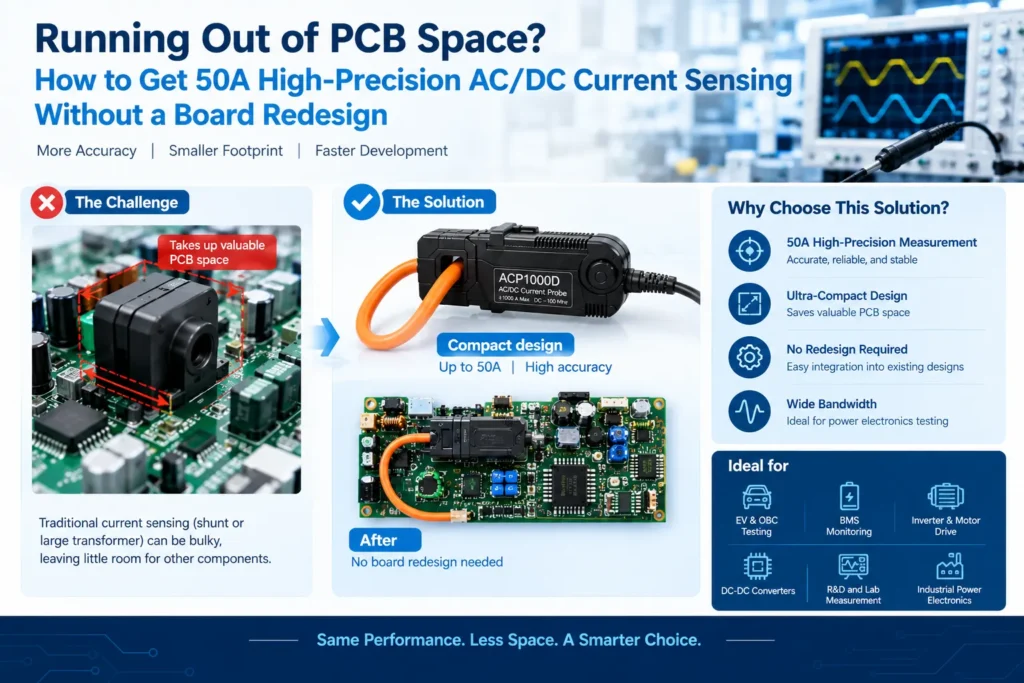
Short answer: When your board is too crowded to add an on-PCB current-sense circuit, the practical fix is to stop sensing current on the board at all. A clamp-on AC/DC current probe measures the conductor from the outside — zero board footprint, no shunt heat, no extra copper — and a compact high-bandwidth probe such as the Vasozk ACP300 covers 50A with ±1% typical accuracy, DC–50MHz bandwidth, and a 5mm jaw that fits into tight assemblies. You get the measurement without redesigning the layout.
The rest of this guide explains why on-board current sensing eats so much space, when a clamp-on probe is the right call, and exactly which specs matter for a 50A high-precision measurement.

Why Does On-Board Current Sensing Take So Much Space?
If you need to sample 50A on the board itself, you have three classic options, and all three cost real estate:
- Shunt resistor + sense amplifier. A 50A shunt has to be physically large to dissipate heat without drifting. Around it you need Kelvin-connection routing, a precision differential amplifier, filtering, and thermal relief copper. The shunt also burns power as heat, which the board then has to manage.
- Hall-effect sensor IC. More compact than a shunt, but still a package plus its magnetic concentrator, supply decoupling, and an analog output chain. At 50A the current path has to run through or very close to the device, which constrains your power routing.
- Current-transformer module. Compact for AC, but it can’t read DC, so it’s out for most power-electronics work where you care about the DC component.
Every one of these forces decisions early in the layout and locks up board area you may not have. On a dense power board, that space often simply isn’t there.
How Does a Clamp-On Current Probe Solve the Space Problem?
A clamp-on AC/DC current probe moves the sensing element off the PCB entirely. It clamps around a wire, bus tab, or component lead and reads the magnetic field without breaking the circuit. Because the measurement happens outside the board, it changes the space equation completely:
- No board footprint. Nothing is added to the layout — no shunt, no sense amp, no Hall IC, no extra routing.
- No added heat. A good probe has very low insertion impedance, so it doesn’t load the circuit or dump heat into the board the way a 50A shunt does.
- Non-intrusive. You clamp it on where you need it and remove it when you’re done. You can move the measurement point without re-spinning the board.
- True AC/DC. A Hall + current-transformer hybrid design reads from DC up through the rated bandwidth, so you see the steady-state current and the switching behavior on the same trace.
For a prototype that’s already laid out, or a production board where every square millimeter is spoken for, this is usually the fastest path to a clean 50A measurement.

What Specs Actually Matter for a 50A High-Precision Measurement?
Not every current probe is suited to precise 50A work. These are the parameters that decide it:
Current range and resolution
50A should sit comfortably inside the probe’s range with margin, not near its saturation point. Equally important is the small-signal resolution — a probe that resolves down to tens of milliamps lets you see ripple, standby current, and small fluctuations riding on the 50A level, not just the bulk current.
Bandwidth and rise time
High-precision rarely means DC-only. If you’re sampling 50A on a switching converter or motor drive, the interesting detail lives in the harmonics and switching edges, often into the MHz range. A probe with DC–50MHz bandwidth and a rise time of a few nanoseconds reproduces those edges honestly. The common engineering rule is to pick bandwidth at three to five times the highest frequency you need to resolve.
Accuracy
±1% typical accuracy is the benchmark for measurements you’ll base design decisions on. Anything looser turns efficiency and loss calculations into guesswork.
Jaw opening and probe-head size
This is the spec that most directly answers the “small package” question. A compact jaw — on the order of a few millimeters — lets the probe reach a single conductor or component lead inside a crowded assembly, where a bulky clamp physically won’t fit.
Insertion impedance
Low insertion impedance keeps the probe from loading the circuit under test and from heating up during sustained measurement, which is what preserves accuracy over a long run.
Which Vasozk Probe Fits a Compact 50A Measurement?
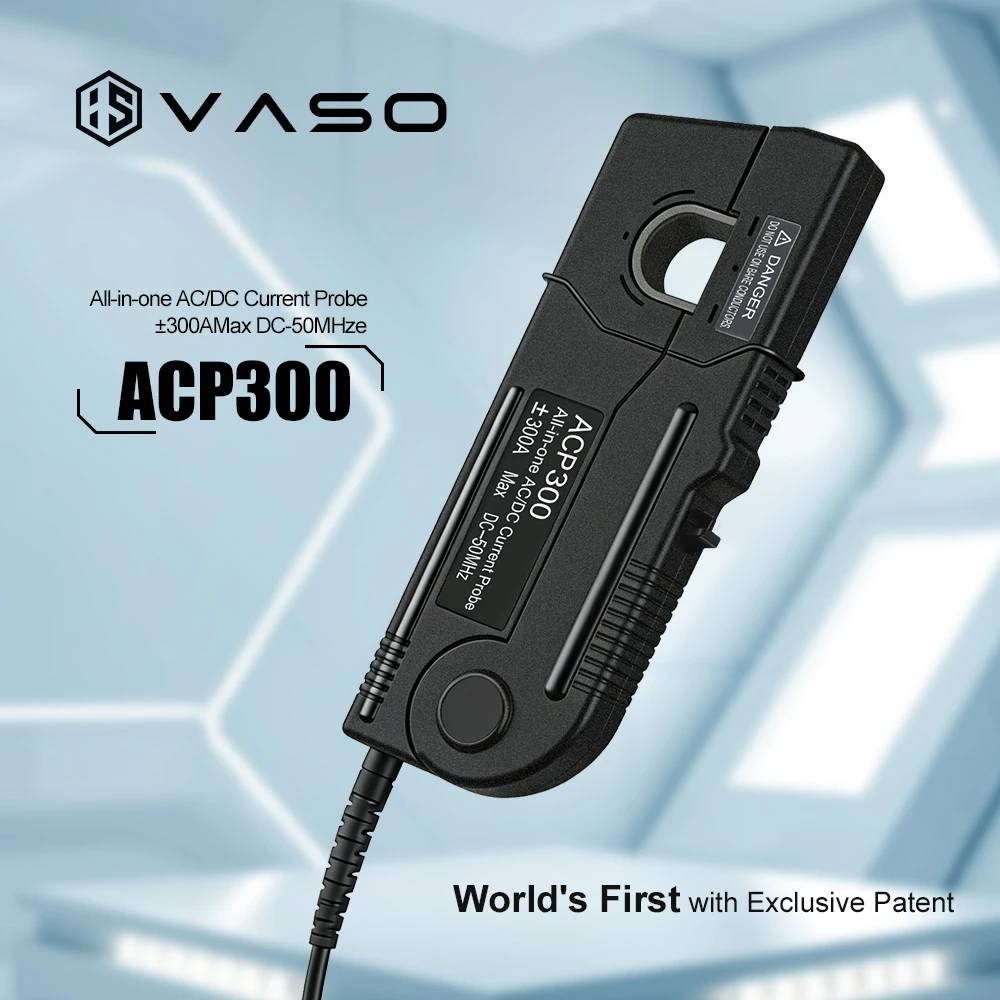
For 50A high-precision sensing in a space-constrained setup, the Vasozk ACP300 is the natural fit. It’s the smallest and highest-bandwidth model in the ACP line, built specifically for precision small-to-medium-current work rather than brute-force high current.
| Parameter | Vasozk ACP300 | Why it matters for 50A high-precision work |
|---|---|---|
| Max current | ±300A | 50A sits well inside the range with ample margin — no saturation risk |
| Ranges | 30A / 300A | 50A measured on the 300A range; drop to the 30A range for finer low-current detail |
| Min. sensitivity | 0.02A / 0.2A | Resolves small ripple and standby currents riding on the 50A level |
| Bandwidth | DC–50MHz | Captures DC plus switching-edge and harmonic content |
| Rise time | ≤7ns | Reproduces fast switching transitions faithfully |
| Typical accuracy | ±1% | Reliable enough to base loss and efficiency decisions on |
| Jaw opening | 5mm | Compact enough to clamp a single lead or conductor in a tight assembly |
| Probe head | 17.5 × 1.8 × 4cm | Small head that reaches into confined board areas |
| Operating temp | -40°C to +85°C | Works on the bench, in a thermal chamber, or in the field |
| Power | Oscilloscope-direct or USB-C | No separate bench adapter to find space for |
The ACP300 reads 50A on its 300A range, and when you want to zoom in on small-current behavior you switch to the 30A range for its 0.02A resolution. The 5mm jaw and slim head are what make it usable where an on-board sensor won’t fit and a large clamp won’t reach.
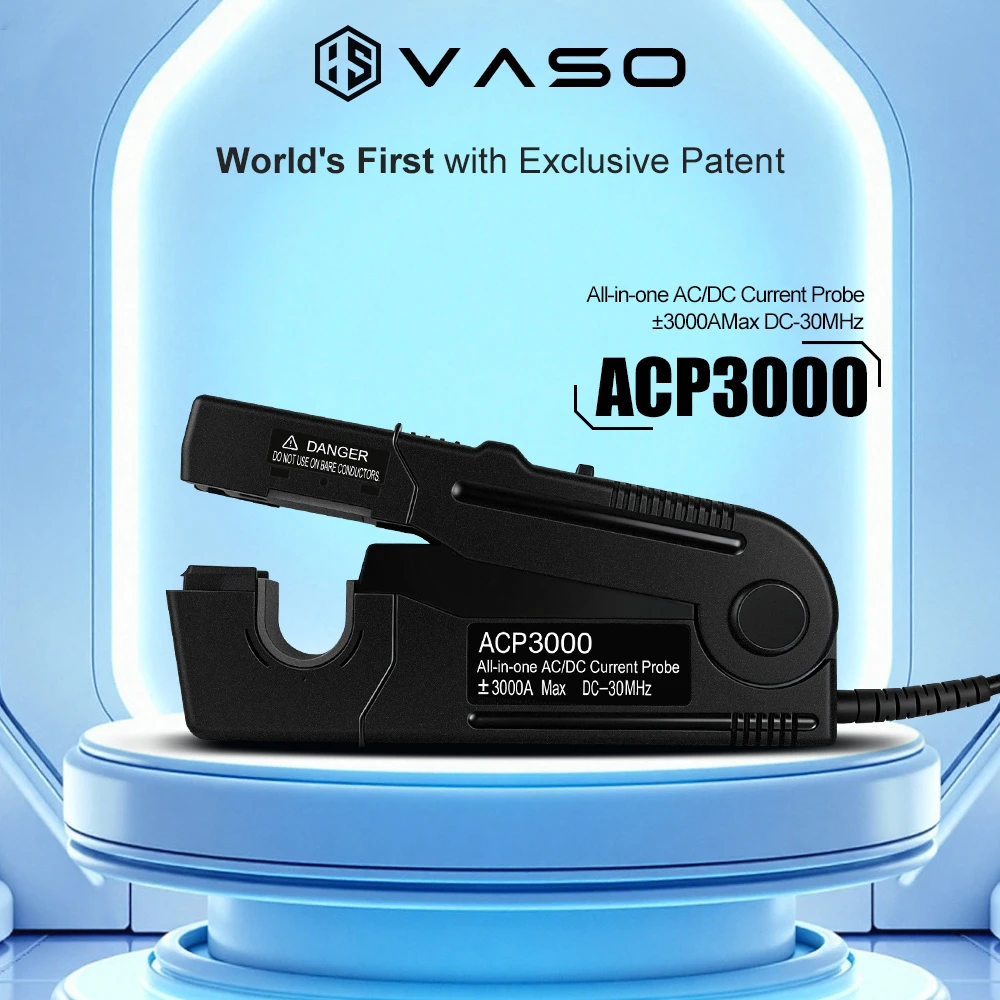
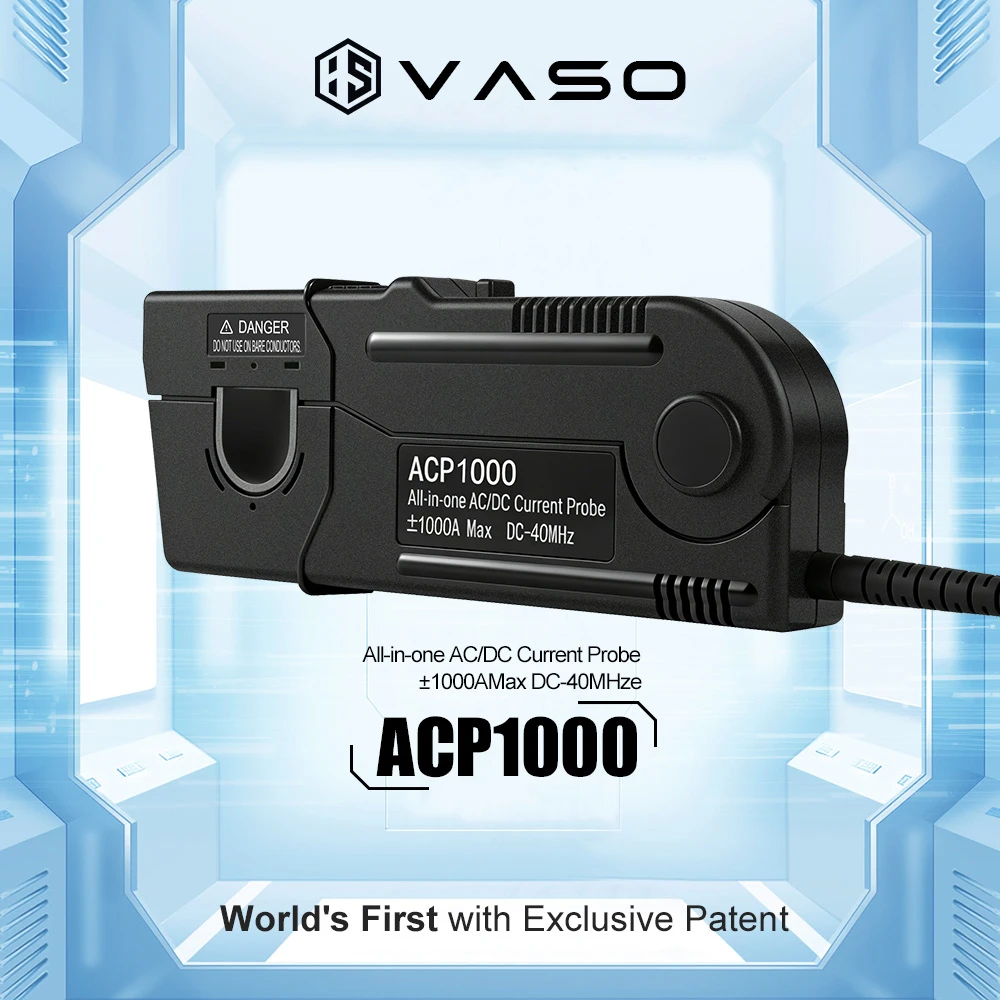
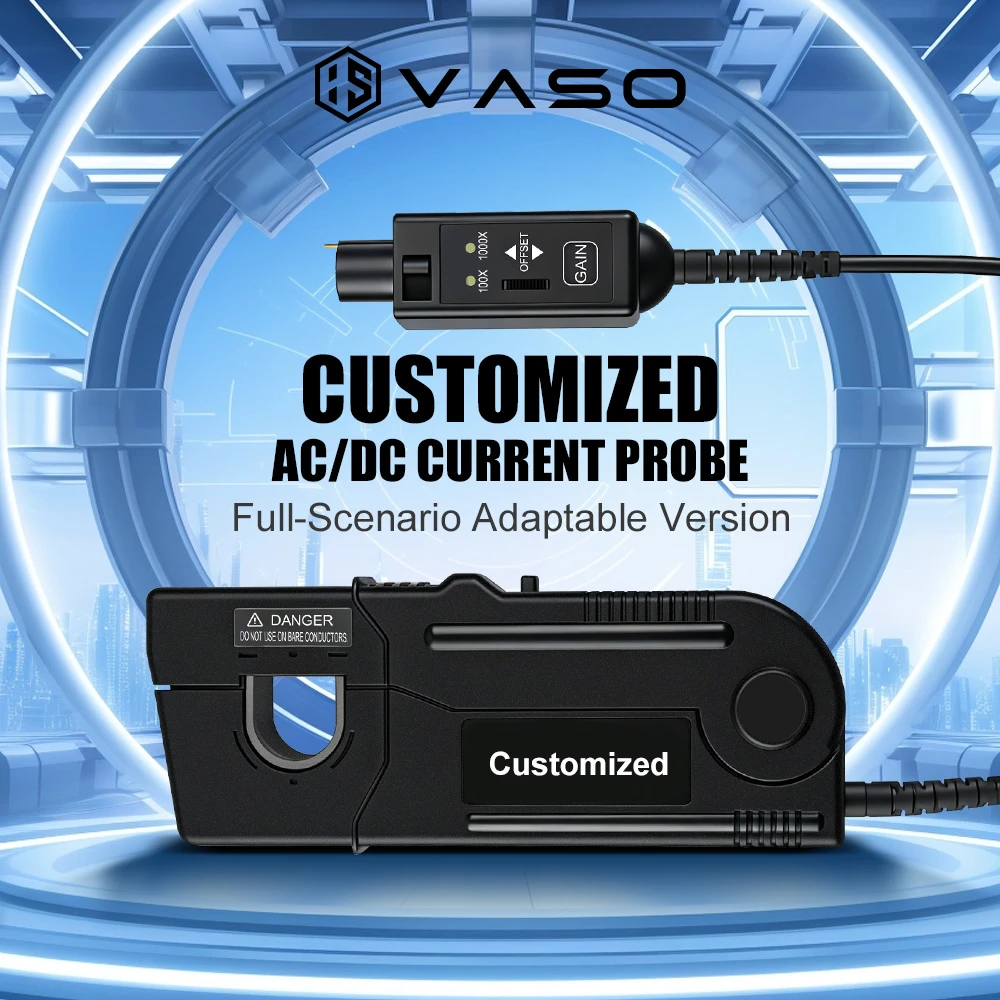
If your current later climbs past the low-hundreds of amps — a bigger converter, an EV drive, a central PV inverter — Vasozk’s ACP1000 (±1000A, DC–40MHz, 10mm jaw) and ACP3000 (±3000A, DC–30MHz, 20mm jaw) step up the current range, and a customized line covers anything from 1A upward.
A Quick Decision Check
Use a clamp-on probe instead of an on-board sense circuit when:
- The board is already laid out, or there’s no room to add a shunt and amplifier.
- You need both DC and AC/switching content on the same measurement.
- You want to move the measurement point without re-spinning the board.
- Heat from a 50A shunt would be a problem.
- You need the measurement for validation and debug rather than as a permanent in-system sensor.
Stick with an on-board sensor only when the current reading has to be part of the shipping product’s control loop — in which case the probe is still the right tool for validating that sensor during development.
Frequently Asked Questions
Can one probe measure both DC and AC current? Yes. An AC/DC probe uses a Hall-effect sensor for the DC and low-frequency part of the signal and a current-transformer action for the higher-frequency part, combining them into one continuous reading from DC up to the rated bandwidth. The Vasozk ACP300 covers DC–50MHz this way.
Is a clamp-on probe accurate enough for high-precision 50A work? A probe rated at ±1% typical accuracy, like the ACP300, is accurate enough to base efficiency, loss, and ripple analysis on. Keep the measured current inside the probe’s range with margin and center a thin conductor in the jaw for best results.
Does using a current probe require changing my PCB? No. That’s the main advantage. The probe clamps around an existing conductor or lead, so there’s no board redesign, no added components, and no extra routing.
Why not just use a shunt resistor for 50A? A 50A shunt is physically large, dissipates significant heat, and needs careful Kelvin routing and a precision amplifier — all of which consume board space and add thermal load. A clamp-on probe avoids every one of those costs.
What jaw size do I need? The jaw has to physically fit the conductor you’re clamping. For a single lead or thin conductor in a crowded assembly, the ACP300’s 5mm jaw is usually the right size. For heavier busbars, step up to the ACP1000 (10mm) or ACP3000 (20mm).
How is the probe powered? The ACP300 draws power either directly from a compatible oscilloscope or over USB-C, so there’s no separate bench power adapter to accommodate.
The Takeaway
A crowded PCB doesn’t force you to compromise on current measurement. By moving the sensing off the board, a compact clamp-on AC/DC probe gives you a clean 50A high-precision reading — DC through switching detail — with no layout change, no added heat, and no lost board area. For that compact, high-accuracy case, the Vasozk ACP300 hits the balance of range, bandwidth, resolution, and physical size, with the rest of the ACP line and a customized option available when the current or conductor size grows.
Specifications referenced from the Vasozk ACP300, ACP1000, and ACP3000 product documentation.