
Testing high-current circuits—especially in EV charging systems, inverter burn-in, or industrial motor drives—exposes a recurring problem: most 300A probes aren’t built for the job. They need their own power supply, overheat after 30 minutes, and crack if dropped on a factory floor. We built the ACP300 specifically to remove those constraints.
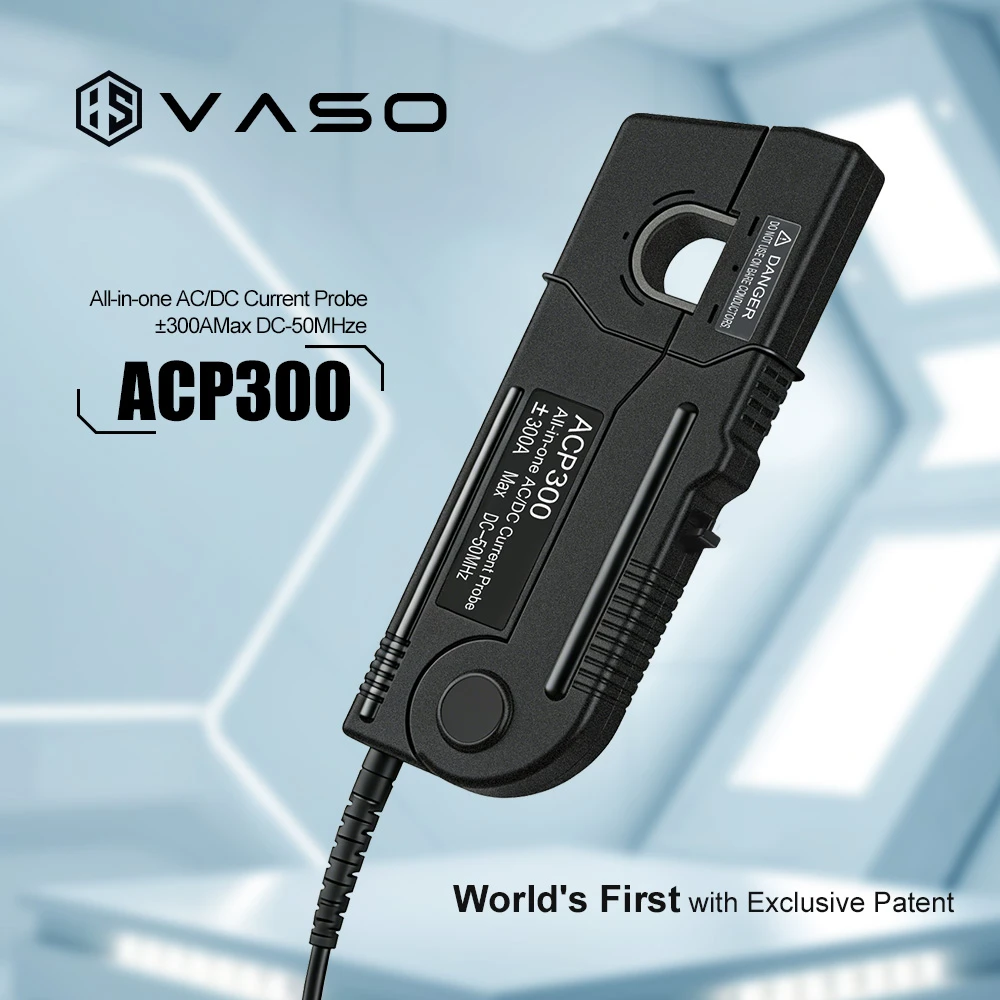
No External Power Supply Needed
If you’ve ever set up a multi-channel current measurement on a drive cabinet, you know the frustration of running separate power adapters for each probe. Every extra cable is a potential failure point—especially during extended automated testing.
The ACP300 draws power directly from the oscilloscope through a patented adapter. There’s no separate supply to manage, no loose DC jack to intermittently fail at hour six of a 24-hour run. The adapter is compatible with mainstream oscilloscope platforms, so it works with what’s already on the bench.
Practical impact: Cleaner setups, fewer connectors to troubleshoot, one less thing to fail during overnight tests.
Rated for Continuous 300A Operation—Not Just Burst
Most 300A probes are rated for short-duration use—typically 30 minutes or less. That’s fine for a quick characterization sweep, but it creates real problems for production burn-in tests, EV durability cycles, or any application where you need the probe running continuously for hours.
The ACP300 is designed for 24/7 continuous operation at up to 300A peak. The ultra-low insertion impedance keeps the internal sensor cool under sustained high-current loads. Bandwidth covers DC to 50MHz, so it handles both the fundamental and higher-order harmonics in switching power supplies and motor drives without frequency rolloff.
Measurement accuracy: Typical ±1%, maintained across the full operating range—not just at low currents.
Built for Industrial Environments, Not Just Lab Benches
High-frequency current probes typically use precision mechanical structures that don’t survive field conditions. One drop onto a concrete floor, and the jaw alignment is gone.
The ACP300 uses a reinforced industrial housing with deliberate impact resistance. It’s been designed for the kinds of environments where probes actually get used: production lines, field service vans, rail maintenance depots. The operating temperature range of -40°C to +85°C covers most outdoor and factory environments where standard equipment would fail.
This matters for total cost of ownership. A probe that survives a drop and keeps working is worth more than a slightly more accurate one that needs replacing every few months.
Where the ACP300 Is Actually Used
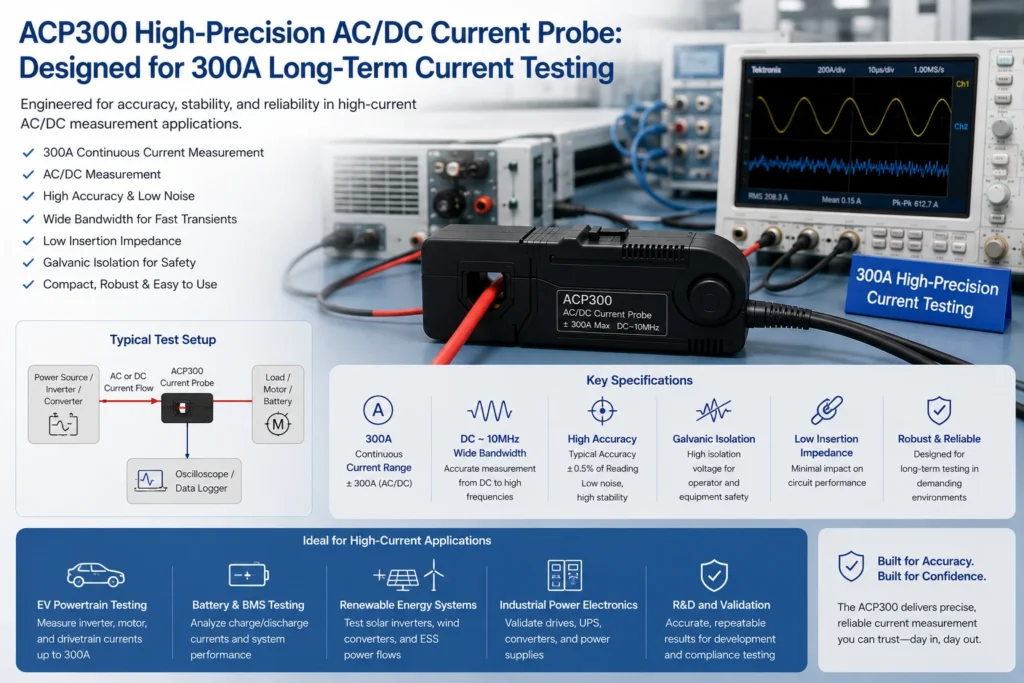
New energy and EV: Continuous current monitoring in on-board chargers, battery pack testing, and charging station validation. The 24-hour run capability is particularly relevant here—EV durability testing doesn’t stop after 30 minutes.
Power electronics: Inverter and VFD testing, UPS burn-in, switching supply characterization. The DC–50MHz bandwidth captures the full switching waveform including high-frequency components.
Industrial automation: Large motor drives, servo systems, CNC power circuits. The ruggedized housing is relevant here—factory floors aren’t lab environments.
Rail transportation: Traction control systems and on-board electrical diagnostics in high-vibration, high-impact environments.
R&D and compliance labs: Circuit analysis, EMC pre-compliance, product verification. The ±1% accuracy satisfies most lab-grade measurement requirements without the overhead of a full power analyzer.
Field service and maintenance: Distribution cabinet diagnostics, on-site fault analysis, outdoor maintenance. Probe runs from the oscilloscope power alone—no need to source a power outlet for the probe itself.
Specifications
| Parameter | Specification |
|---|---|
| Peak Current | 300A |
| Current Type | AC/DC |
| Bandwidth | DC–50MHz |
| Measurement Accuracy | Typical ±1% |
| Power Supply | Direct from oscilloscope via patented adapter |
| Housing | Reinforced industrial-grade |
| Operating Temperature | -40°C to +85°C |