
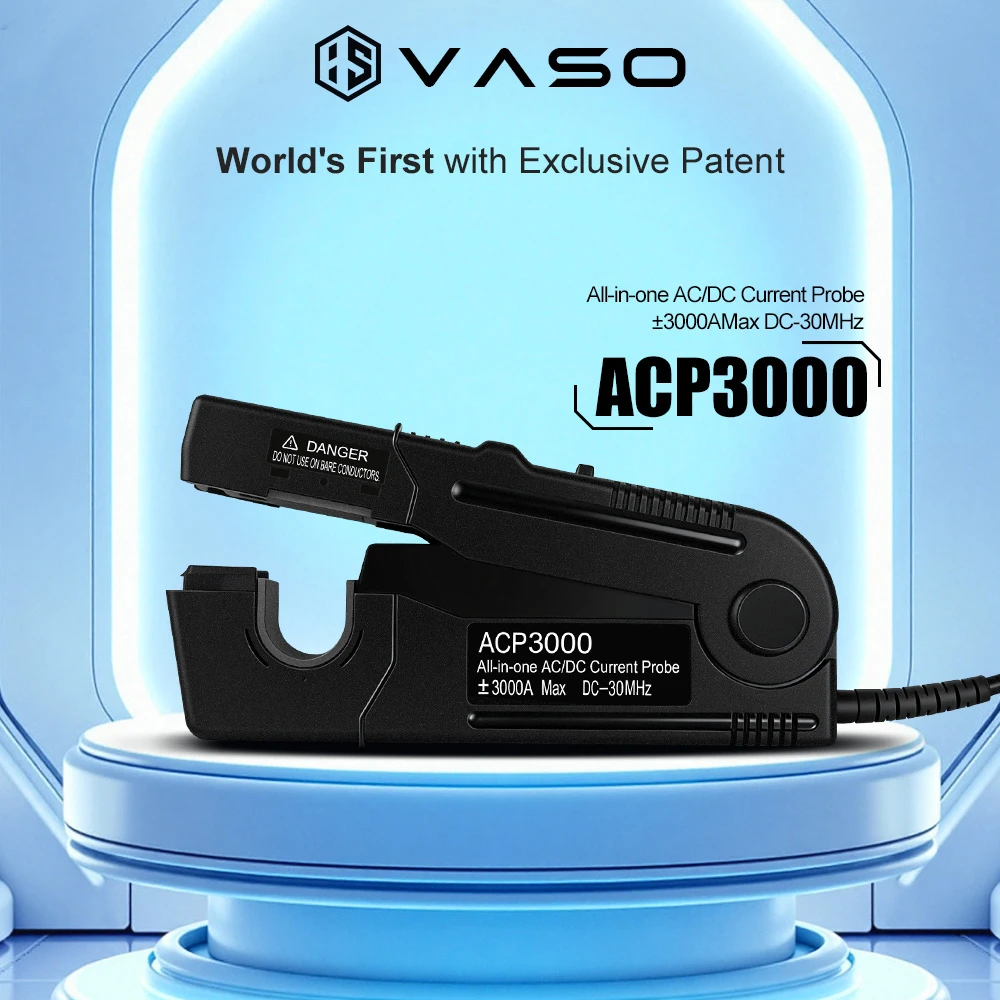
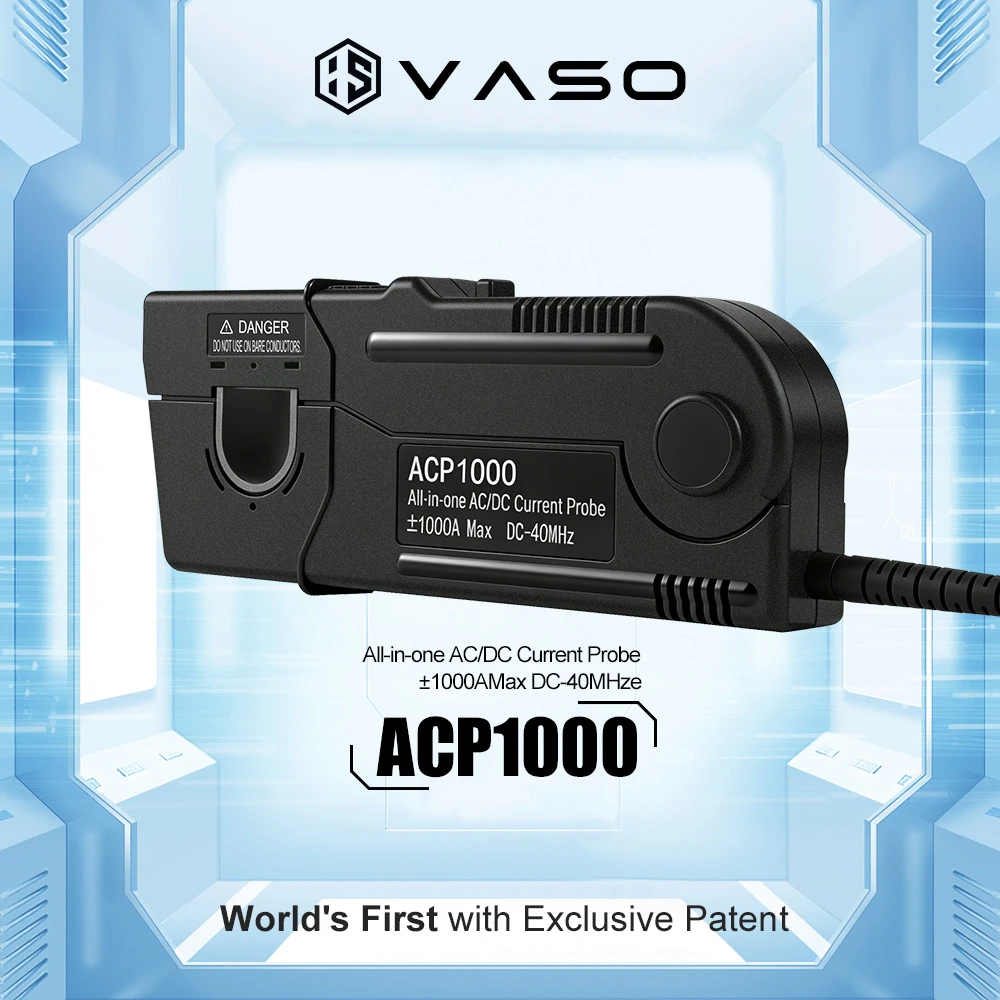
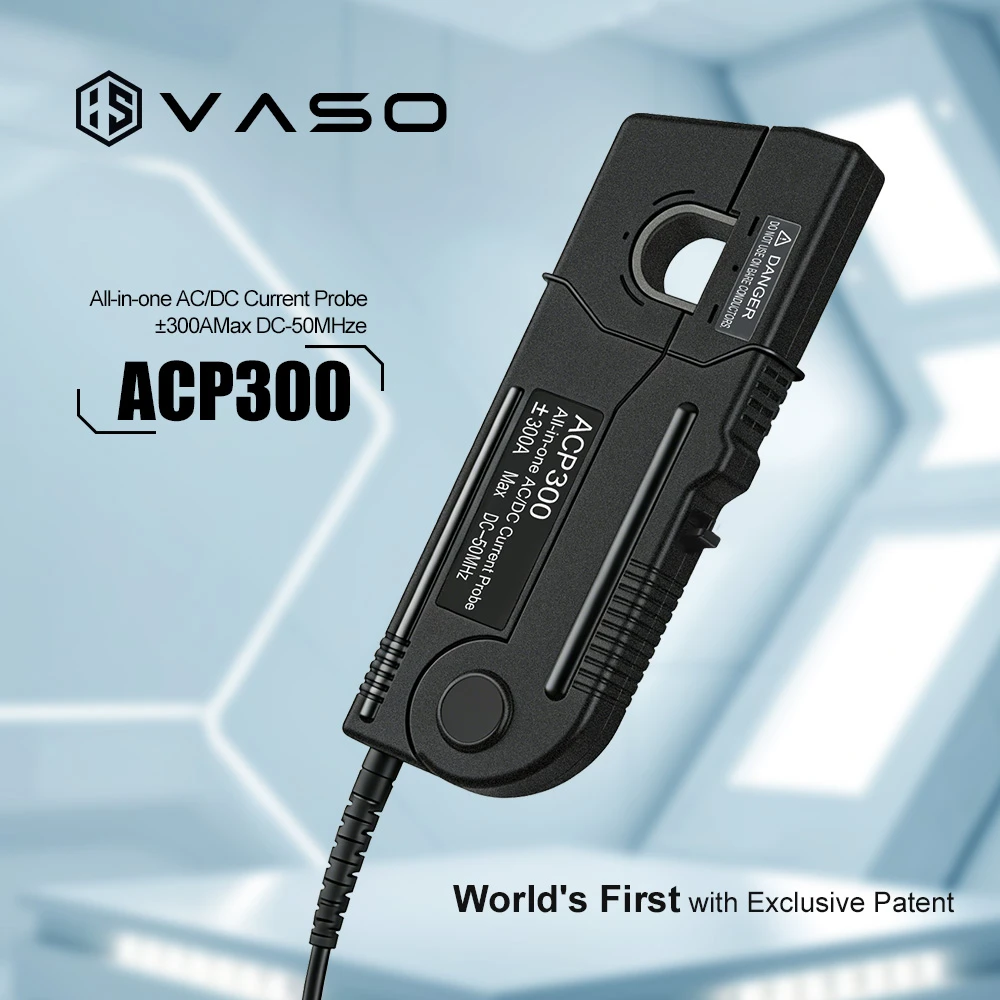
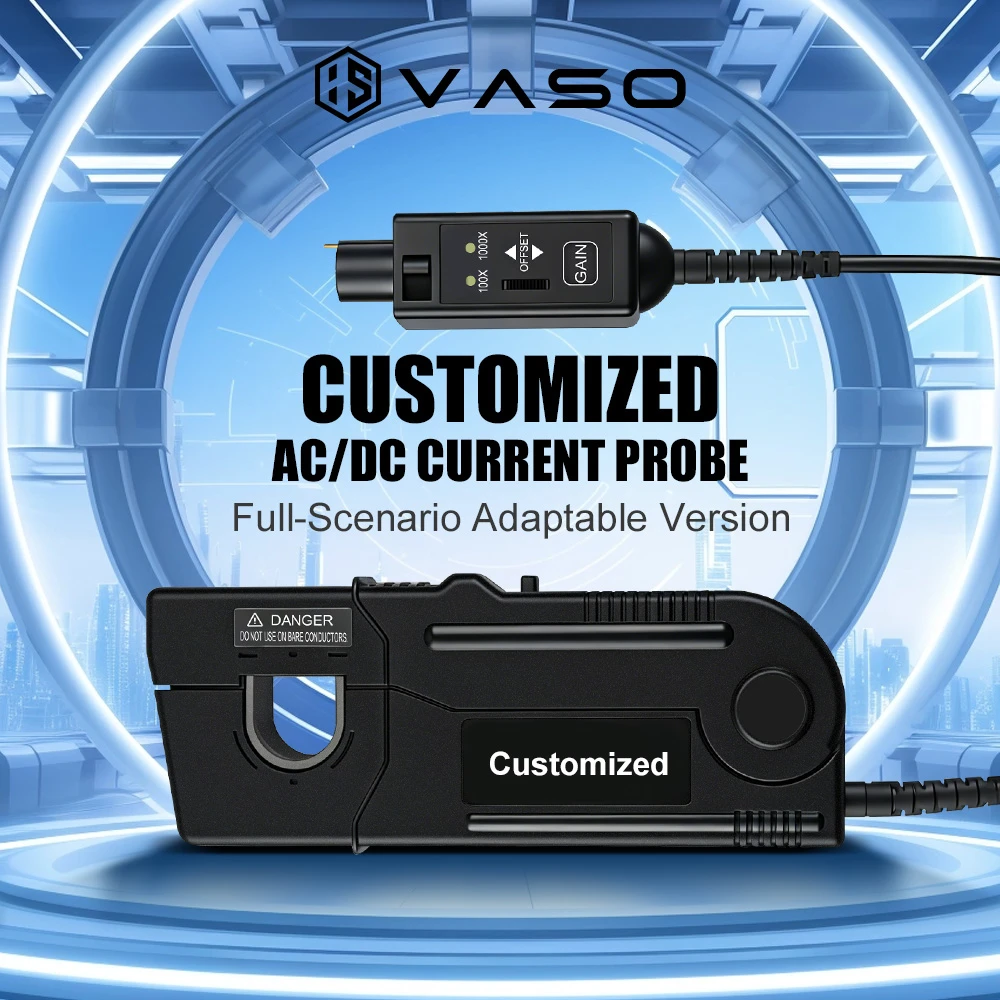
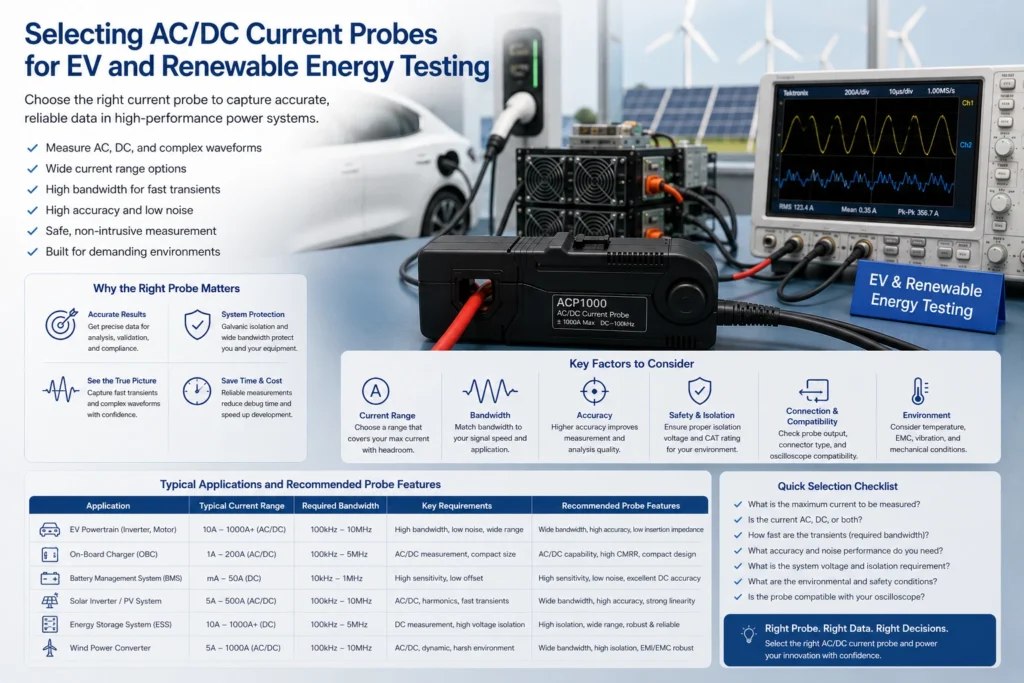
The current probe is rarely what engineers argue about. Budgets go toward the power analyzer, the oscilloscope, the dynamometer. The probe gets picked from whatever is on the shelf, or ordered based on current rating alone. In EV and renewable energy testing, that approach produces measurement errors that are often large enough to change engineering conclusions — and quiet enough that nobody catches them.
This article covers the technical criteria that actually matter when selecting an AC/DC current probe for four common application areas: traction battery testing, inverter and motor drive evaluation, EV charging station (EVSE) measurement, and photovoltaic plus battery storage systems.

Why These Applications Break the Rules of Conventional Current Measurement
Most electrical test environments are built around AC. The utility frequency is stable, the current waveform is roughly sinusoidal, and the measurement instrument only needs to handle one dominant frequency component. Current transformers work well in this context. They are mature, inexpensive, and accurate at power frequencies.
EV and renewable energy systems violate nearly every assumption that makes this simple.
The signal is DC, or a mix of DC and AC. Traction batteries, PV arrays, and DC-coupled storage systems produce direct current. A conventional CT produces zero output for DC — it measures flux change, not flux. Any probe specified for AC-only operation is immediately disqualified for the DC-side measurements that make up a large portion of EV and storage testing.
Switching frequencies have moved well above the audio band. Silicon carbide (SiC) and gallium nitride (GaN) power devices, now standard in high-efficiency traction inverters and onboard chargers, switch at 20 kHz to over 100 kHz, with harmonic content extending further. The current waveform seen by a power analyzer contains the fundamental motor frequency — which tracks RPM and can range from below 10 Hz to above 1 kHz — plus switching frequency components and their harmonics. A probe with a 10 kHz bandwidth will measure the fundamental correctly and miss everything else. Switching losses calculated from such a measurement will be wrong.
Efficiency margins are small. A traction inverter running at 97% efficiency dissipates 3% of input power as heat. If the current probe introduces a 1% amplitude error, the calculated efficiency shifts by roughly that same amount — turning a 97% reading into 96% or 98%, both of which lead to different design decisions. At these efficiency levels, measurement uncertainty is not an academic concern.
The cable cannot be cut. In laboratory setups it is sometimes possible to insert a shunt resistor in series with the load to measure current precisely. On a vehicle running on a chassis dynamometer, the high-voltage bus is a sealed, high-voltage system. A clamp-on probe that clips around the cable without breaking the circuit is the only practical option.
Sensing Technology: What the Datasheet Does Not Explain Clearly
Four technologies appear in AC/DC current probes used for power measurement. Understanding their operating principles explains why the specifications look the way they do.
Hall Effect sensors use the voltage that develops perpendicular to a current-carrying conductor placed in a magnetic field. The sensor sits in the air gap of a magnetic core that concentrates flux from the measured conductor. Hall sensors respond to static magnetic fields, which means they measure DC. Their bandwidth extends into the megahertz range, making them usable for switching waveform capture. The limitation is temperature sensitivity: the Hall voltage and the offset voltage of the amplification circuit both shift with temperature. For a probe sitting in an engine bay or an outdoor enclosure, this drift is not negligible. Over a multi-hour measurement at varying temperatures, the accumulated offset error can exceed the probe’s nominal accuracy specification.
Fluxgate sensors use a different physical mechanism. A secondary winding driven by an alternating excitation current saturates the magnetic core periodically. When a DC (or low-frequency AC) current flows through the primary, the positive and negative saturation transitions become asymmetric. This asymmetry is detected and used to generate a feedback current that exactly cancels the measured flux — a null-balance principle. Because the output is based on nulling rather than directly sensing flux magnitude, the result is essentially independent of temperature. Fluxgate probes have narrower bandwidth than Hall Effect types (typically DC to a few hundred kilohertz), but their DC accuracy and stability are substantially better. For battery testing where measurements run for hours and the result is an integrated energy value, the Fluxgate approach is the technically correct choice.
Rogowski coils are an air-core device — no magnetic core at all. The coil links the magnetic field around the conductor, and the output is proportional to the rate of change of current (di/dt), which is then integrated electronically to recover the current waveform. Because there is no magnetic core, there is no saturation, no hysteresis, and no permeability temperature dependence. Rogowski coils handle very large and very fast currents without the nonlinearity problems that affect iron-core sensors at high flux densities. The catch is that the electronic integrator sets a lower cutoff frequency — DC and very slow signals are not measured. For applications that need only AC, particularly at high frequencies or very high current levels, a Rogowski coil is often the right answer.
Current transformers are the familiar iron-core inductive sensors used throughout power measurement. They are highly accurate at the frequencies they are designed for, robust, and widely available. The AC-only limitation is fundamental: a CT measures flux change, and a steady DC current produces no flux change. For any application with a DC component — which covers most EV and storage scenarios — CTs are not applicable on the DC side.
Application Scenarios
Traction Battery Charge and Discharge Testing
The measurement objective in battery testing is current during charge and discharge cycles. The primary use of this data includes state-of-charge (SOC) estimation, charge/discharge efficiency calculation, and compliance testing against standards such as WLTP, which requires integrating current and power over a full driving cycle.
The dominant characteristic of battery current is that it is DC, often several hundred amperes, with a ripple component from the charger or inverter at switching frequency. The measurement challenge is not bandwidth — the signal of interest is slow — but DC accuracy and long-term stability.
For a 500 A battery pack being measured over a four-hour charge cycle, a probe with a DC drift of 0.1 A/hour accumulates 0.4 A of error by the end of the test. On a 500 A signal this looks negligible, but the integrated energy error — which compounds throughout the measurement — can meaningfully affect SOC calculations and efficiency figures.
The conductor geometry is another practical constraint. 800 V battery systems use heavy copper cables. With insulation and shielding, the outer diameter of a high-current bus cable often exceeds 40 mm, and in some platforms reaches 50 mm. A probe with a jaw opening of 32 mm, regardless of its current rating, cannot be used. This is a detail that frequently causes problems when probes are ordered without physical verification against the actual cable.
Recommended specifications for this scenario:
| Parameter | Specification |
|---|---|
| Sensing technology | Fluxgate |
| Rated current | 500 A to 1,000 A |
| Frequency range | DC to 100 kHz |
| Amplitude accuracy | ≤ ±0.3% |
| Phase accuracy | ≤ ±0.1° |
| Operating temperature | −40 °C to +85 °C |
| Maximum conductor diameter | ≥ φ50 mm |
Traction Inverter and Motor Drive Efficiency Evaluation
Inverter efficiency testing requires measuring both DC input power (battery side) and three-phase AC output power (motor side) simultaneously. The difference between input and output is inverter loss. At efficiencies above 95%, accurately measuring a small difference between two large numbers puts stringent demands on both the probes and the analyzer.
The current signal on the AC output side contains the fundamental at the electrical frequency of the motor — typically 50 Hz to 600 Hz for passenger vehicles at highway speeds, but potentially extending to 1 kHz or above for high-speed motors. Superimposed on this are the switching frequency components from the SiC inverter, which at 50 to 100 kHz switching frequency generate harmonics well into the hundreds of kilohertz. Whether these harmonics contribute significantly to motor loss depends on the application, but to correctly account for them in efficiency calculations the probe must have enough bandwidth to capture them.
Phase accuracy is the specification that most directly governs the accuracy of power calculations. Power factor in a traction drive can approach unity at full load. When power factor is 1.0, power equals the product of RMS voltage and RMS current. When power factor is 0.95, power is 95% of that product. A 0.1° phase error between the voltage and current channels shifts the calculated power factor by a small but measurable amount — in a high-efficiency, near-unity power factor system, the resulting power error is not small relative to the loss being measured.
For three-phase measurements using three separate current probes, inter-probe phase consistency matters as much as individual probe phase accuracy. If one probe has a phase lead of +0.1° and another has a phase lag of −0.1°, the error in three-phase power is determined by the 0.2° difference, not the 0.1° individual specification.
| Parameter | Specification |
|---|---|
| Bandwidth | ≥ 500 kHz; ≥ 2 MHz for detailed switching analysis |
| Rated current | 200 A to 500 A |
| Sensing technology | Hall Effect (bandwidth priority) or Fluxgate (accuracy priority) |
| Phase accuracy | ≤ ±0.1° |
| Multi-channel phase consistency | Specify and verify across probes used together |
EV Charging Station (EVSE) Measurement
An EV charging station involves two distinct measurement planes. On the AC input side, the signal passes through a power factor correction (PFC) stage whose switching frequency generates harmonic content that may need to be measured for efficiency analysis. On the DC output side, the signal is predominantly DC — the rectified, regulated output delivered to the vehicle.
The DC output measurement is where accuracy requirements are sharpest. DC fast chargers (Level 3 DCFC) typically operate at 150 kW to 350 kW output. Regulatory frameworks in several jurisdictions impose metering accuracy requirements on commercial charging stations — in some markets, energy meter accuracy must be within 0.5% or better. A current probe is one element of that measurement chain, and its accuracy specification needs to be consistent with the overall system accuracy requirement.
The physical environment for EVSE field testing differs from a laboratory. Cable routing at a charging station is not designed for measurement access. Probes need to be deployable in confined spaces, often at awkward angles, without a second operator to hold things in place. Single-hand operation and a secure latching mechanism are functional requirements, not ergonomic preferences.
| Parameter | Specification |
|---|---|
| AC measurement | True RMS, DC to 100 kHz |
| DC measurement | Full DC capability, ≤ 0.5% accuracy |
| Rated current | 200 A to 600 A |
| Safety rating | CAT III 600 V minimum; CAT III 1000 V for 800 V+ platforms |
Photovoltaic and Battery Energy Storage Testing
PV and storage testing covers a range of current magnitudes depending on where in the system the measurement is made. At the string level, a PV array might produce 10 A to 20 A per string. At the DC combiner output, aggregate current from multiple strings can reach several hundred amperes. The storage battery during peak discharge may deliver 500 A or more.
Outdoor installation exposes the probe to environmental conditions not seen in laboratory testing. Temperature swing from morning to afternoon can exceed 30 °C at the measurement point, and seasonal variation is larger still. A Hall Effect probe with a temperature coefficient of 50 ppm/°C sees a 0.15% shift over a 30 °C change — modest in isolation, but an additional error source on top of calibration uncertainty.
MPPT algorithms in PV inverters continuously adjust the operating point to maximize power extraction. The resulting current variation is not sinusoidal and not periodic in a simple sense. The probe needs sufficient dynamic response to track these variations without phase lag that would distort integrated energy calculations.
Instrument interface compatibility deserves attention here because field test systems often combine equipment from different manufacturers. A probe with a BNC output and 10 mV/A sensitivity connects straightforwardly to most oscilloscopes. Connecting the same probe to a power analyzer that expects a specific input impedance, or that uses a proprietary interface for automatic scaling, may require adapter hardware or manual sensitivity configuration. Confirming this before the measurement is simpler than diagnosing systematic errors afterward.
Five Specification Traps
Bandwidth over-specification. The assumption that higher bandwidth is unconditionally better does not hold. A probe with 100 MHz bandwidth passes high-frequency interference, EMI from adjacent power electronics, and other noise sources that a more limited probe would reject. When the measurement objective is the fundamental current at 50 Hz or the switching frequency at 50 kHz, a probe with 500 kHz bandwidth captures what is needed and rejects noise that would otherwise contaminate the measurement. Bandwidth should be matched to the measurement requirement, not maximized.
DC saturation on small signals. Consider a battery being measured at 200 A DC with a 5 A ripple from the charger. The probe must handle 200 A without saturating its core, and simultaneously resolve 5 A of ripple with adequate resolution. This combination — high rated current and sufficient dynamic range at the low end — is not guaranteed by either specification alone. A probe rated for 300 A but with 1 A resolution may have insufficient dynamic range to clearly resolve the 5 A ripple in the presence of 200 A DC. This scenario needs to be explicitly checked against the probe’s dynamic range and resolution specifications.
Current rating without conductor diameter. 800 V platforms use heavy-gauge cables. The outer diameter of a high-voltage bus cable, accounting for insulation, shielding, and any braided covering, commonly exceeds 40 mm. A probe rated for 500 A with a 32 mm jaw opening is physically incompatible with this cable regardless of its electrical specifications. Verifying jaw opening against actual cable outer diameter — measured, not estimated — is a step that gets skipped and causes problems.
Phase consistency in multi-channel setups. When measuring three-phase power with three current probes, the relevant phase specification is the consistency between channels, not the individual probe specification. Two probes each specified at ±0.1° could, in the worst case, differ by 0.2°. For accurate three-phase power calculations, probes should be calibrated and matched as a set, or the inter-unit variation should be specified and accounted for in the uncertainty budget.
Interface mismatch. Output connector type, output sensitivity in mV/A, output impedance, and any proprietary Auto-ID features all need to match the input of the connected instrument. High-end power analyzers that support probe Auto-ID automatically configure scaling and range when a compatible probe is connected, eliminating a class of setup errors. In production test environments where the same probe-instrument pairing is configured repeatedly by different operators, Auto-ID compatibility is worth confirming.
A Practical Decision Framework
The selection criteria reduce to a sequence of questions that can be answered before opening a product catalog.
First: does the signal contain DC? If yes, CT and standard Rogowski implementations are out. If no, the DC-capable technologies are still valid options — they are not wrong choices for AC-only applications, they are just more expensive than necessary.
Second: what is the required measurement duration? For measurements lasting more than 30 minutes, DC drift specification is the dominant accuracy driver for Fluxgate and Hall Effect probes. Verify that the drift specification over the full measurement duration stays within the acceptable error budget, not just that the nominal accuracy specification is met at initial calibration.
Third: what is the highest frequency component that matters? Switching harmonics at 5× the switching frequency, even if attenuated, can affect loss calculations. Set bandwidth to cover the frequency range that contributes meaningfully to the measurement, with some margin.
Fourth: what is the physical environment? Jaw opening, operating temperature range, safety rating category, and connector type are constraints that eliminate candidates before any accuracy comparison is needed.
Fifth: what instrument will this probe connect to? Verify interface compatibility, scaling, and whether Auto-ID or manual configuration is required.
Working through these five questions narrows the field to probes that are technically qualified for the application. Selecting among those qualified options based on cost, availability, or additional features is a secondary decision.
Closing Observation
The measurements that AC/DC current probes support in EV and renewable energy development — inverter efficiency, battery energy throughput, charger power delivery — feed directly into engineering and regulatory conclusions. A probe that introduces a 0.5% systematic error is not a precision instrument being used slightly outside its optimal range; it is a source of structured bias that propagates through every calculation downstream.
The probe selection criteria in EV and renewable energy applications are not more complex than other domains. They are different from what most electrical engineers encounter in conventional power systems work, and the mismatch between familiar assumptions and actual requirements is where errors originate. Treating the current probe as a precision measurement instrument that requires specification against the actual measurement task — rather than a commodity accessory — is the adjustment that produces reliable results.